

Crack open Boot Hill expecting a modern “story engine” and you’re going to be very disappointed. Modern tabletop gamers go looking for boxed‑text drama cues and ways to roll dice instead of talk to other players, then sneer when all they find are stats, guns, and a town full of people who don’t care about their character’s tragic backstory. That’s not a flaw. That’s the point.
Boot Hill isn’t a modern RPG, and you’d be a fool to judge it by those standards. It just isn’t built for that. Instead, it comes from the Braunstein school — the primordial soup where role‑playing crawled out of the wargaming swamp. Back then, nobody waited for the GM to unveil Act Two. Players walked into a shared world with their own agendas, and the referee simply kept the peace long enough to record the casualties. Story wasn’t delivered; it leaked out of the crossfire.
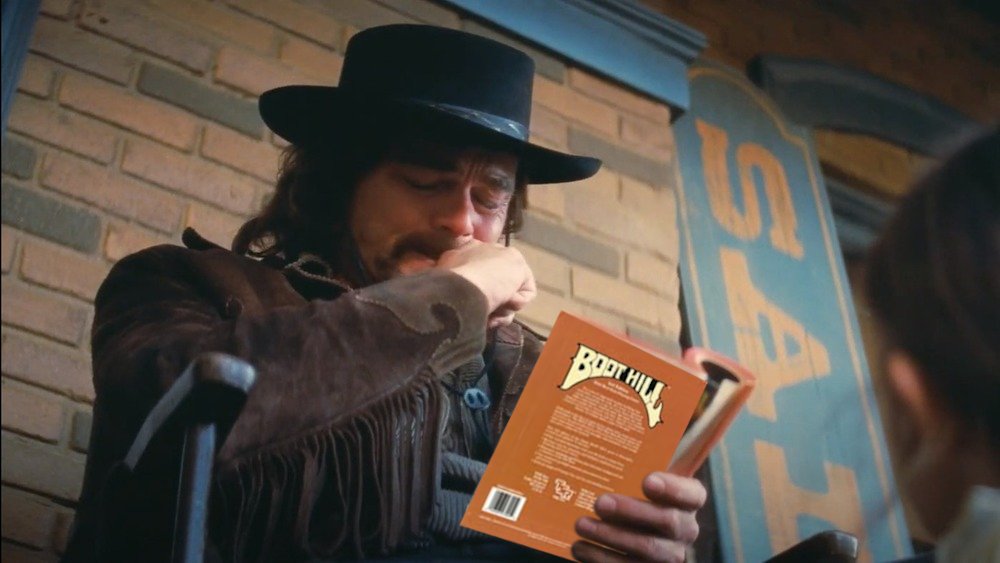
The game’s sample towns – Promise City, Fort Griffon – aren’t “adventure paths.” They’re sandboxes with a thin coat of dust and a few factions sketched in. The book hands you a setting, shrugs, and says, “Go make trouble.”
Modern critics love to declare that Boot Hill “fails as an RPG,” which is true only if you define “RPG” as “a guided tour through the GM’s screenplay.” Judging a 1975 wargame‑descendant by 1995 narrative standards is like judging a horse by its in‑flight beverage service. You’re using the wrong yardstick.
The real giveaway that Boot Hill is a Braunstein at heart is its combat system — a masterpiece of natural selection. One gunfight teaches players everything they need to know: violence is a terrible business model. There’s no heroic padding, no hit‑point mattress to fall back on. You get shot, there’s a one-in-five chance you get domed, and the undertaker gets paid. Even light wounds put you down for three weeks of recovery.
This isn’t a bug. It’s a reinforcement loop.
Because when the rules make violence expensive, players discover the joys of not dying. They start thinking like frontier operators instead of Hollywood gunslingers. Blackmail? Efficient. Bribery? Civic engagement. Bluffing? The West’s original conflict‑resolution mechanic. Every non‑violent tactic becomes attractive because every violent one comes with a built‑in funeral.
This is exactly how Braunstein play works: the environment teaches the players how to behave. The referee doesn’t need to lecture anyone about diplomacy. The rules themselves whisper, “Try anything but shooting.”
Once players internalize that lesson, the table transforms. The gunfights become punctuation marks, not paragraphs. The real game is the scramble between them — the alliances, the betrayals, the whispered deals in the saloon. Maybe a fist fight or wrasslin’ match (which can be recovered from in a day or two), if both parties are amenable to it. Reputation becomes a resource. Secrets become currency. Every conversation is a chance to tilt the town in your favor without catching a bullet for your trouble.
And because the world (read: other factions) reacts to what players do, the consequences are the story. Not a pre‑written one, not a “narrative arc,” but the organic kind that grows out of people with goals colliding inside a shared space. That’s Braunstein play with a cowboy hat and a mean streak.
So no, Boot Hill isn’t a narrative RPG. It never tried to be. It’s a conflict engine living in a sandbox, a game where the smartest gunfighter is the one who never draws. Treat it like a plot dispenser and you’ll be disappointed. Treat it like a town full of people who want things – and a referee willing to let the chips fall where they may – and suddenly everything snaps into focus.
Stop waiting for the story. Start causing it.