
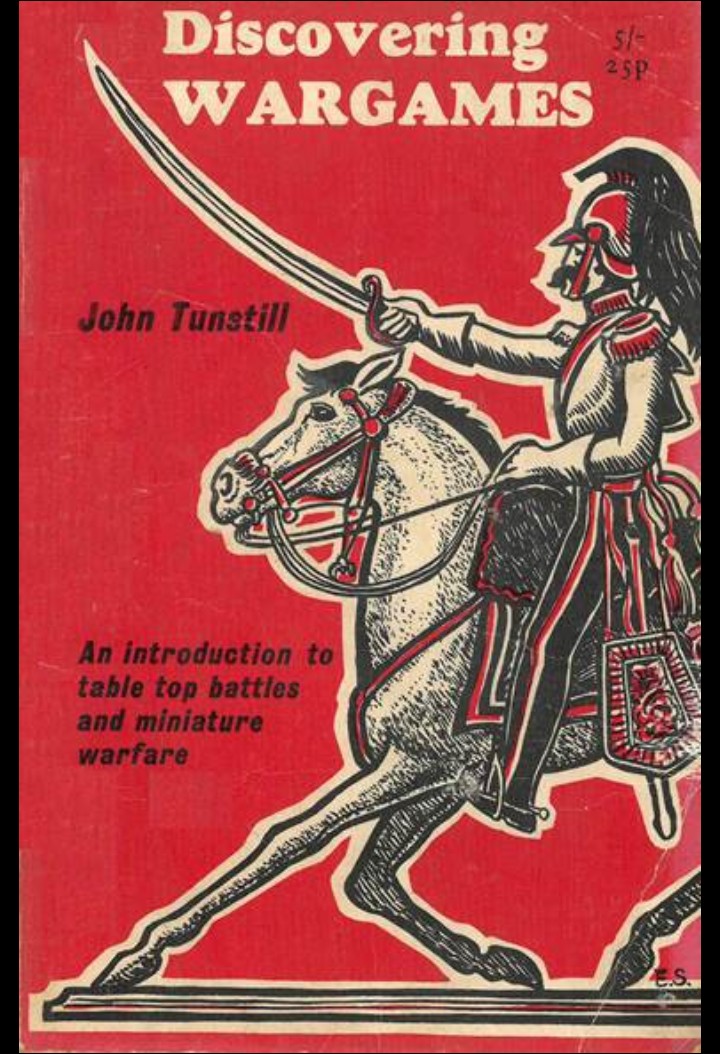
There’s a nasty myth out there that the standard movement rate in miniature wargames is six inches because Tony Bath thought it just “feels right”. Maybe Tony use that number, maybe he didn’t come I can’t be bothered to check, but a mathematical refutation of that myth is present in John Tunstill’s Discovering Wargames.
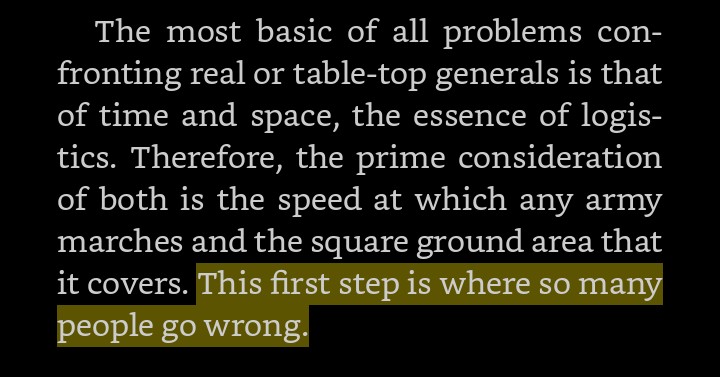
Truer words were never spoken, and once again we see how the wargaming experience mirrors that of the real world. The first step is where so many people go wrong, indeed.
The Six‑Inch Revelation
Modern gamers take the “standard” infantry move of 6″ for granted. But ask where that number comes from, and you’ll get a lot of shrugging. Tradition, maybe. Ease of measurement. Something Games Workshop did once and everyone copied.
Except Tunstill had the answer in 1969 – back when games workshop was just a twinkle in a couple of nerds eyes – and he didn’t arrive at it by tradition or convenience. He did the math.
Using a ground scale of 1 mm = 1 yard, six inches on the table works out to:
6″ = 152.4 mm
152.4 mm = 152.4 yards
And 152 yards just happens to be the distance an infantryman can cover in about a minute or two of battlefield time. Not a jog, not a desperate sprint, just a brisk, purposeful advance. In other words, a realistic tactical movement rate.
That alone would be enough to earn Tunstill your respect. But he didn’t stop there.
Movement Meets Musketry
Smoothbore muskets, the workhorses of 18th‑century warfare, had a maximum effective volley range of roughly 150 yards. Sure, you could lob a ball farther, but if you ackshully wanted to hit something other than the horizon, you closed to that decisive distance.
So when Tunstill sets movement at roughly 152 yards per turn, he’s not vibecoding. He’s aligning movement with the decisive range of musketry, and sticking to the previously established ground scale.
That one decision reshapes the entire character of the game.
When movement equals effective fire range:
- Units can cross the “safe” zone and enter danger in a single turn
- Firefights are short, sharp, and violent
- Melee becomes the natural resolution of combat
- Maneuver matters, but hesitation kills
In other words, you get a tabletop that behaves like the real battlefields of the er. It is fast, decisive, and dominated by morale and nerve rather than long‑range attrition.
The Modern Echo
Modern rulesets still use Tunstill’s numbers, they just don’t know they’re doing it.
Pick up moat mass‑battle game today and what do you see? A 6″ infantry movement and a small arms ranges of 12″ to 24″.
That’s a move‑to‑shoot ratio of 1:2 or 1:4
Designers will tell you this is for “balance” or “playability,” but the truth is simpler. Tunstill solved the geometry of the battlefield so elegantly that everyone else has been unconsciously copying him ever since.
Even games that have nothing to do with 18th‑century warfare. Fantasy battles, sci‑fi skirmishes, you name it, they still orbit the gravitational pull of that six‑inch standard. It just feels right, and now we know why.
The Forgotten Wisdom
What makes this delightful is that Tunstill wasn’t trying to be clever. He simply asked:
- How far can a man move in a minute?
- How far can a musket shoot with effect?
- What happens when you put those two facts on a table?
That’s it. No spreadsheets. No special rules bloat. No “cinematic” abstractions. Just a clean, historically grounded model that produces the right feel without needing to force it.
And because it’s grounded in reality, it scales. Change the weapons, change the turn length, change the era. Movement and range remain locked in a meaningful relationship. The battlefield still makes sense.
The Takeaway
If you ever needed proof that the early pioneers of the hobby knew exactly what they were doing, this is it. John Tunstill didn’t just write an introductory book; he laid down a piece of design logic so solid that half a century later, the hobby is still standing on it.
The six‑inch move might be a tradition and a convenience, but it’s also the mathematical fingerprint of real warfare, translated to the tabletop by a man who understood that good rules start with good reasoning.
If you’ve never cracked open Discovering Wargames, do yourself a favor. There’s gold in those pages, and some of it has been hiding in plain sight right there on your gaming table this whole time.