
Never been a fan of the Giant stompy robot genre. Whether it’s print, video, the war games, something about inverse square law always put me off. Until now. When Gondor lights the beacons, the Rohirrim take to the saddle
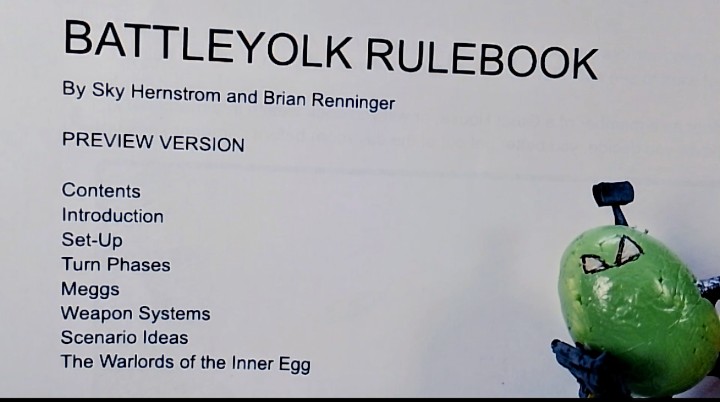
When a brilliant author like Schuyler Hernstrom teams up with a tabletop gaming walking encyclopedia like Brian Renninger, astute gamers sit up and take notice. Also, a regular intellectual gamer like me.

Enter Battleyolk, the most authentic throw back to the kind of mid-1980’s games that once graced the pages of (The Dragon) magazine, from the keen focus on playability to the glib and semi-humorous theme, and even down to the artwork, it hits all the notes of the best gaming had to offer. It neatly presents a playable mecha-game in a new-to-the-genre format and with tongue just enough in cheek to soften even my hardened heart.
The dangers of stripping down and competing with a venerable game like Battletech are legion. That game has its fans for a reason. It challenges players to focus on a host of issues and feeds them a steady stream of important choices through the game. The game length turns games into a sort of intellectual marathon, demanding a high focus for long stretches, which leads to many games hinging on who can avoid lapsing the longest. In this manner, it actually does a great job evoking the experience of the robot jockeys that it emulates.
For the less formal gamer, and those of us that prefer all-out sprints, that asset quickly turns to liability. The gruelling cognitive load weighs heavily on a mind seeking relaxation. Casual friendly mech games have probably been attempted on numerous occasions in the genre about that. With my limited exposure all I can tell you is that Battleyolk serves up the same juggling act – manage a trio (or omelet) of stompers (called meggs) – with a lot less effort.
You still have to balance out ammo use, heat buildup, and damage tracks that distinguish stompybot games from their more organic brethren, but the big one – heat – operates as more of a build up of critical failures than a constant bleeding. This pushes the mechanics of heat into the back seat without pushing it all the way into the background. It’s a toddler you have to be aware of, and one that can ruin your day, but one that lets you mainly focus on the road ahead.
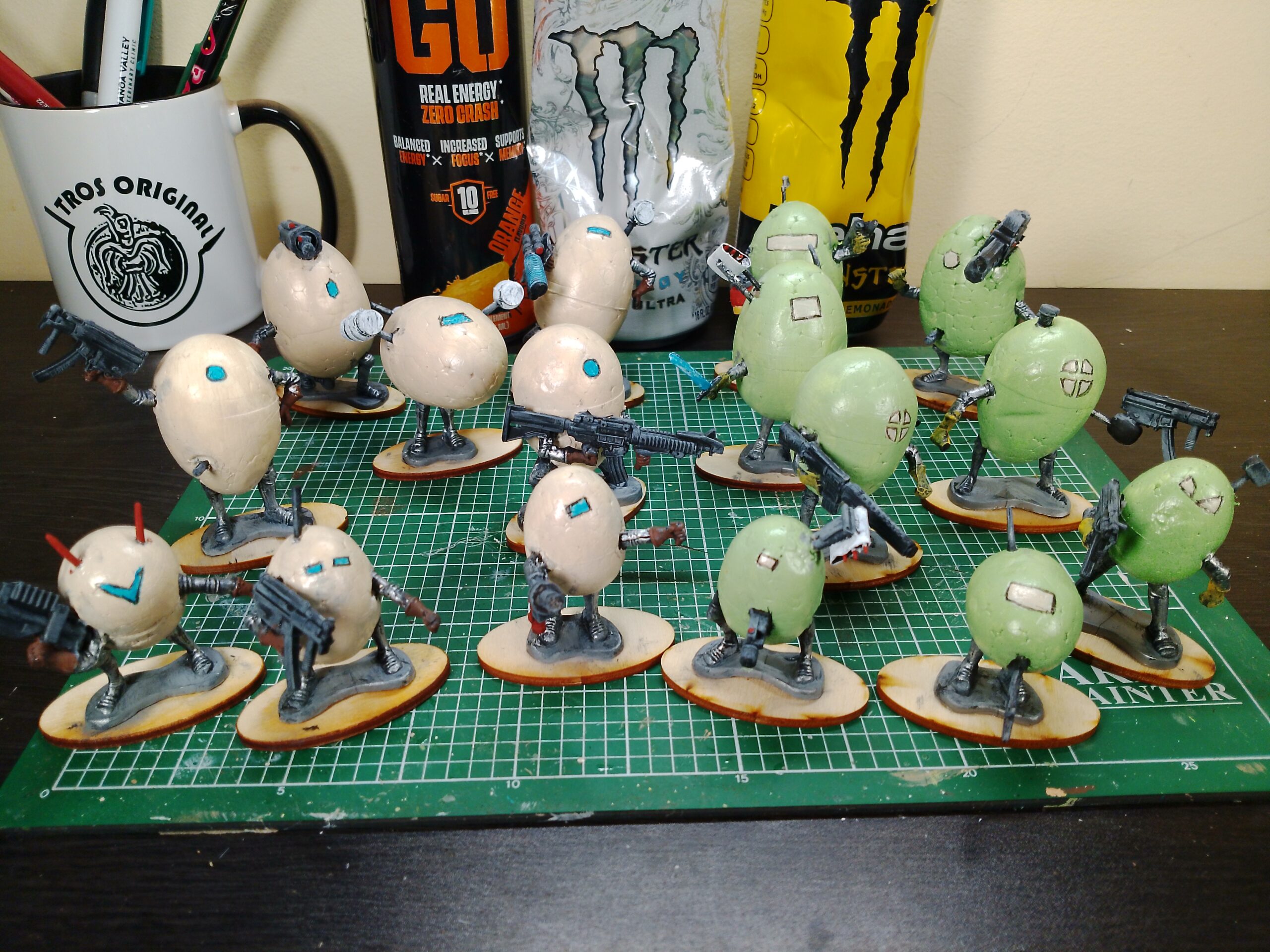
The game, still in beta testing, includes a roster of 16 different designs of meggs in three sizes. If you are a very boring person you can build a roster seeking to min-max, but the game does not provide you with Bill points. Instead, it encourages you to use a random meggs from each size, because real generals know you go to war with the forces fate gives, which very rarely matches the forces you want.
Here are my creations, which seek to replicate the in-game designs as much as possible.
Activation is by alternating units, with each of the five phases (move, shoot, fight, and mindfulness – I told you the game was rather cheeky) completed by both players before moving on to the next.
Combat is a 3D6 roll by the attacker. Before rolling, declare which is the to-hit, which the effects, and (just in case) which is the critical results. The first two will always be relevant, with the to-hit determining which figure suffers the effects of the second die. On a hit, the attacker might do light damage and suffer heat damage or normal damage with no heat, or trigger a critical hit, which you’ve already conveniently rolled. All you have to do is check the critical hit chart. If you miss, then the effects die tells you whether or not you suffer heat. It’s a slick little system that moves fast.
Which describes the game as a whole. It does offer two modes of play – the normal and sedate mode and the EXTREME mode in which in which the meggs are a lot more fragile. Damage piles up faster, and the game is unlikely to last more than a dozen turns before all that’s left is a scramble of shells and innards with one or two battered meggs left to claim victory.
It’s still in beta, with a few odd commissions here and there, which are sure to be ironed out before the game goes to full press. In the meantime, I’ll show you what it can do in the usual manner in the usual places.