
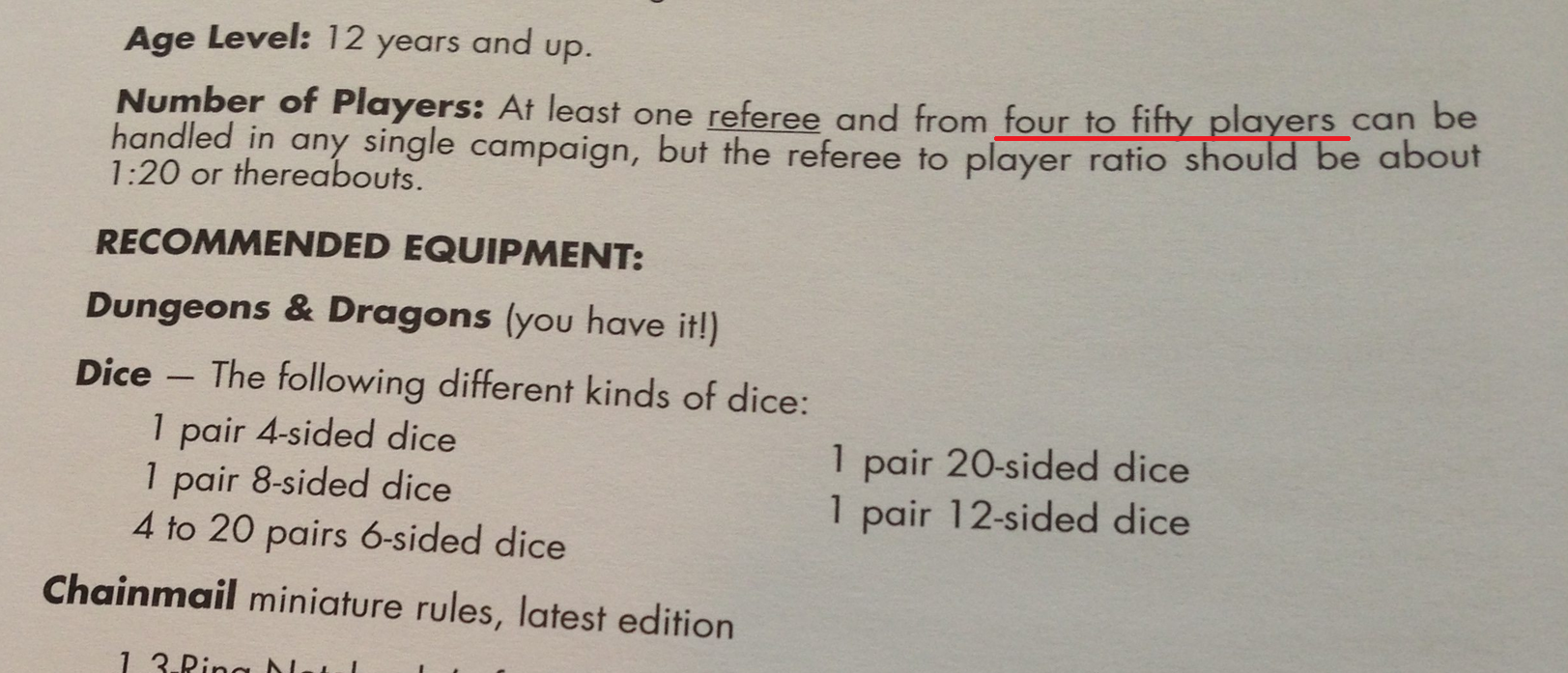
The original D&D equipment list calls for “from four to fifty players”, but for decades conventional wisdom told us this only meant that the campaign had a stable of players who dipped in and out of standard session play. Today, this is known as West Marches style play, and it indicates normal sessions with a rotating cast of characters, and most critically requires that every session begin and end in the same safe town.
Ben’s campaign side-stepped a number of what he saw as stumbling blocks – or as we think of them “opportunities for greater player freedom and involvement” – by limiting the campaign to wilderness exploration and dungeon delving. This drastically limited the complexity of the campaign and the ability of players to interfere with each other’s plans. As play was strictly confined to the sessions, the best you could do is loot a dungeon firstest and bestest, and maybe leave a few traps for the next unwary players.
That was the state-of-the-art in large campaign technology.
More and more conversations are popping up asking how to extend West Marches beyond its original one-note approach to RPGs. This generally means incorporating more politics, factions, and domains into the campaign. Doing so ain’t easy under the Sessions Only model of play, and so you see a lot of people asking about how to manage the large information flow, asynchronous play, faction rosters and data, and so on. As is usually the case when you have a total upheaval in the understanding of a field of study, most people are asking questions in isolation and unwilling to abandon their preconceived notions. They want the effects of a rocket engine, without giving up the piston.
The easy answers to their problems involve RPG technology pioneered by the BROSR, such as 1:1 time, downtime actions, player-vs-player actions, and faction play.
That’s not exactly a Braunstein, but it’s close enough to provide covering fire so that the community at large can pretend like the BROSR hasn’t been at the forefront of pushing beyond the borders of West Marches. One thing that can’t be denied is that the BROSR is the only group out there who treat campaign administration as a design discipline. The same design questions now being discussed in multiple places have been systematically studied by them for years.
There are very few people treating campaign operations as a first-class design problem. The BROSR is unusual precisely because it has spent years systematically developing and documenting procedures for scaling campaigns. Most adjacent blogs touch pieces of the problem – open tables, hexcrawls, factions, or persistent worlds – but relatively few tackle the whole operational challenge in the same way. That scarcity is part of what makes the BROSR interesting, regardless of whether one agrees with all of its conclusions.
We’re about where the OSR was around 2008.
Back then, only a handful of small blogs were talking about:
- random tables
- procedures
- player skill
- sandbox campaigns
Five years later those ideas had spread everywhere, to the point that an entire cottage industry existed to support them.
Campaign administration is on a similar trajectory, because once someone has more than a handful active players, they start asking exactly the same questions the BROSR has been documenting for years. More and more Big Names are using BROSR technology without knowing (or admitting) who developed it, which only goes to show that the future of gaming is inevitable. And the future belongs to the BROSR.