
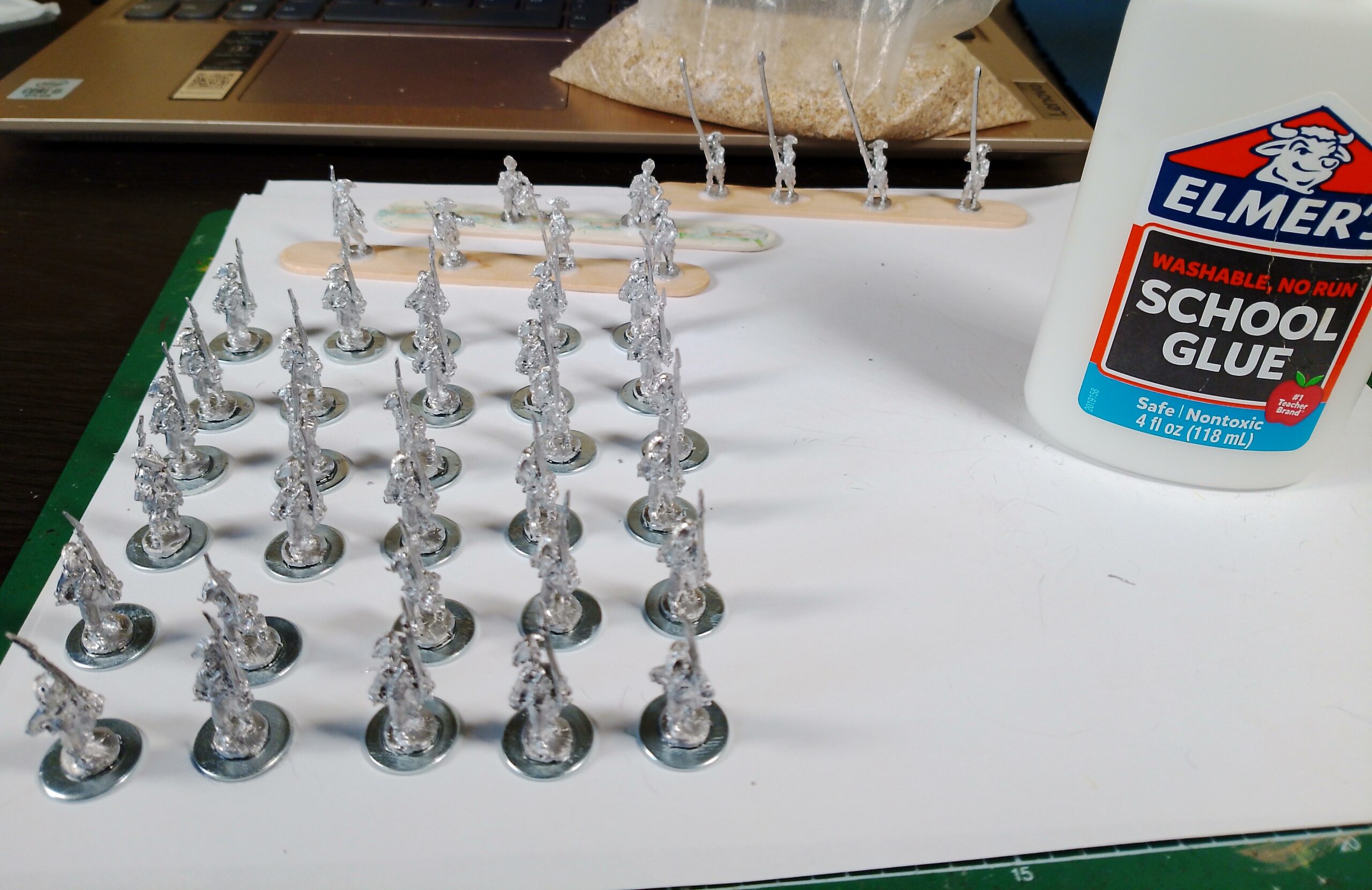
My experience with Rebels and Patriots and to a lesser extent Song of Drums and Tomahawks has led me to the fertile shores and warm waters of wargaming in the American Revolution. It’s always been something of a black-powder little brother to heavy hitters like the American Civil War and Wars of Napoleon. In part this is due to scale and scope. The AWI’s siege of Yorktown put 40,000 into the field, a quarter the size of Gettysburg and less than a tenth that of Leipzig. It’s true, but there’s more to the story and as I delve into the subject I think the more to the story is less to the story.
All three of these eras saw brilliant and larger than life commanders, character-filled units dropping in and out of the spotlight, sideshows and discussions to explore, and conflict raging at scales from handfuls to divisions. But the AWI lacks that critical through-line the others offer. The ACW gives you the heroic efforts of the doomed to defeat Marse Robert. You can trace the general pattern of the war through his spectacular rise, grinding survival, and ultimate loss at Gettysburg. There’s more meat on there, but Bobby Lee gives you the skeleton on which the rest of the fight hangs. Likewise with the Little Corporal and his efforts on behalf of France.
Sure, you’ve got the American Fabius, but his central role wasn’t just to win battles. Washington’s greatest victories were strategic rather than tactical: preserving the Continental Army, holding together a fragile coalition, and simply refusing to lose until British political will gave way. Washington appears and disappears from the campaign record, enduring defeats, avoiding annihilation, and waiting for opportunities created elsewhere. Yorktown, the war’s climactic victory, owes as much to Rochambeau, de Grasse, and French gold as it does to Washington’s command.
Militarily, the American Revolution saw Britain attempt to crush the rebellion by grabbing major cities and curb stomping Washington’s army of local yokels. When that didn’t work, they shifted focus to the south in the hopes Loyalist sentiment would let them strangle the colonies one by one in a steady march up the eastern seaboard. Instead, the southern campaign degenerated into a savage war ofattrition that bled British strength while Washington pinned down their main army in the North. Into this stalemate stepped the French (and their gold and their ships) to tip the scales and Cornwallis found himself trapped in Yorktown and forced to admit defeat.
Now that’s a story, and epic in scope with a large cast of characters spread over half a continent, many of whom never met, and how do you set up the game pieces for what essentially amounts to two wars joined at the hip?
You don’t.
The American Revolution resists the neat campaign arcs of the Civil War or Napoleonic Wars because it was not decided by a single army’s march or a single commander’s genius. It was a war of disconnected campaigns and strategic patience. So you pick one and lean into it, knowing that a victory here trumps the results there. Couple that with a focus on strategic, rather than geographic, constraints. Pair those concepts and you can push maps and army tokens to the back urner as you focus on the real decision points.
Which brings me to my newfound love of the Southern Campaign, especially as a wargamer. It strips away the illusion that wars are won by decisive engagements and reveals the grinding machinery that drives them. Roads secured, supplies delivered, militia rallied, detachments dispatched, battles avoided, and opportunities seized—all of these decisions shaped the outcome long before Cornwallis found himself trapped at Yorktown. Camden, Cowpens, and Guilford Court House become milestones that could have occurred elsewhere and other different conditions, leading to a final showdown in another place and time.
The focus of an American Revolution campaign should not be a list of units and locations. That’s fine when the foundation of the war is symmetric and easily hand-waved away to focus on the glamour of the drums and cannons. Instead, the focus of the American Revolution should mimic something like wargaming the Vietnam War. Put yourself in the shoes of Cornwallis. You’ve got an advantage in military strength most everywhere, but more tenuous in the north? Can you keep them all supplied and Tarleton’s forces present as a threat? Can you keep the locals on your side? Can you press the issue with the rabid hounds of Francis Marion, Nathaniel Greene, and Daniel Morgan baying at your heels?
What this war needs is a better method of putting the player in a position to juggle the same hand grenades that Cornwallis did. The numbers that won this war were those in the quarter master’s books, only some of which were the numbers of men in the field.
And that’s probably what I love most about this era. It feels a lot more like a choose-your-own-adventure, but only if you do it right. The trick is going to be figuring out how.
Stay tuned…