
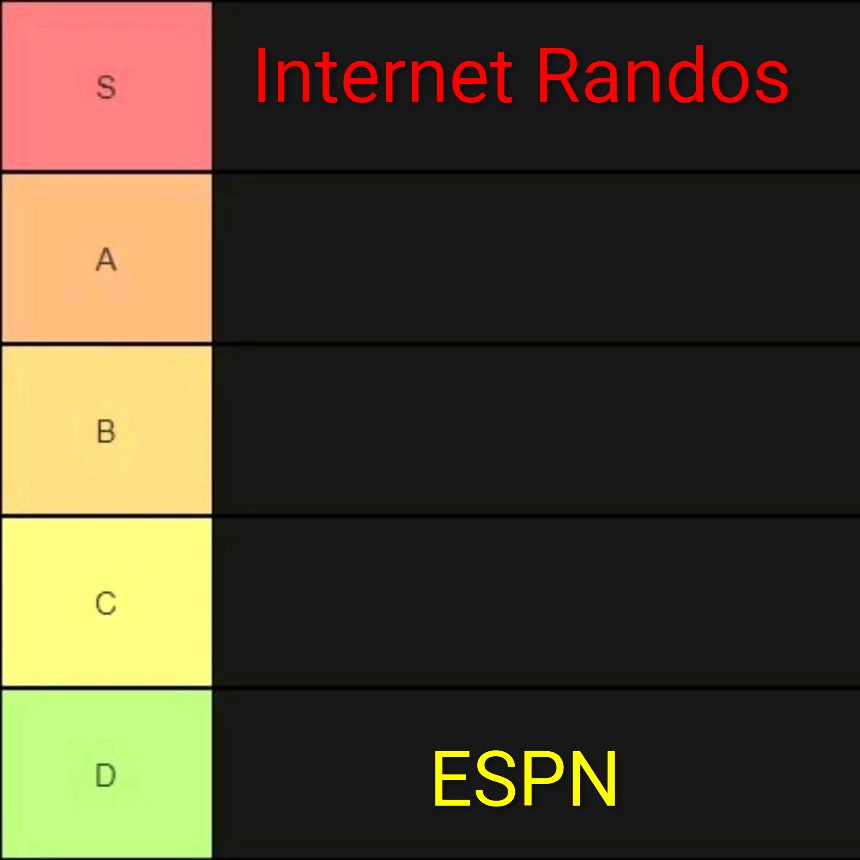
The rigid, 1-though-25 traditional college football poll sucks.
The AP and it’s sycophants love it because it’s built to hide the biases of limp-wristed homosexuals sports-media personalities but I repeat myself. On a 1–25 scale, if ESPN or a voting bloc wants to elevate a team or cushion them after a bad loss, they don’t have to make a jarring, obvious leap. They can just move a team from No. 14 to No. 11 and declare that it’s just routine weekly shuffling. Over the course of a season, these tiny incremental nudges quietly stack up with the result that they can position a 2-loss team right on the playoff bubble without triggering alarm bells. This is how they gave Miami the playoff berth over Notre Dame last year.
And then there’s the pre-season problem. Ordinal lists demand that the Top 25 teams be named before a game is played. Human voters and existing metrics anchor heavily to historical brands, so networks can heavily hype up an entire conference in August and early September, with the result that the back half of the top 25 (spots 15–25) gets filled with mid-tier SEC teams. Once a team is in the top 25, “poll inertia” protects them because AP voters have an incentive to ensure their early assessment was accurate. A mediocre team starts at No. 18, beats nobody of note, drops to No. 22 after a loss, and still stays “ranked”, providing valuable brand legitimacy for weekly broadcast matchups. When challenged about why a team their network broadcasts is ranked ahead of an independent or a team from a different conference with the same record, an ordinal list voter has a useful excuse: “We just think they are one spot better.” The mathematical illusion of a 1-to-25 scale makes subjective favoritism look objective.
The result is a slate of games like today, with a host of teams hyped as top tier talent at the same time everyone admits that half of them aren’t, and that this week is the sorting process by which we’ll know, looking back, which ones deserved the hype they both got. Meanwhile, potentially great games like WVU-OSU get overlooked.
Contrast that with the ubiquitous “tier list” format used everywhere else on the internet these days.
The style of ranking shown in the header image forces categories to be blunt and transparent. You can put real criteria in place that demands solid, strong arguments, and forces people to commit. If you want to aggressively bump a 2-loss SEC team up into Tier B, you can’t hide behind a quiet one-spot adjustment. You have to explicitly shove them into the same box as dominant teams with fewer losses or better wins. Grouping teams into broad brackets (e.g., Elite Contenders, Flawed Good Teams, Bubble Teams) reflects actual parity without pretending you can accurately split hairs between the 14th and 16th best team. The broad categories strip away that illusion of microscopic differentiation. Tiers demand macro-justifications, making blatant favoritism look far more conspicuous and absurd. They eliminate the weekly panic over style-point movements and why my team fell two spots when they won (against a winless MWC team). A team’s tier quality changes in macro-strokes – they make quantum leaps as their clear status changes – not by sliding up and down numerical micro-rungs.
And this feeds better into the current use of the regular season as a cut-off for the 12-team playoff. It’s a cleaner and more clarifying system that naturally captures the automatic bids and at-large playoff slots without needing a rigid, argue-inducing 1-to-25 ladder. The arguments remain as you make the case for whether Team A or Team B belong in the A-tier, but you strip away all the talk of which teams should be nudged just a little bit above the other. If you label your tiers correctly, it makes it a lot more certain what we’re arguing about.
Here’s my humble suggestion, along with where the standings would lie as this post goes live. Note that my tiers expands the landscape to a 40-team watch list, which is more inclusive (and that, I am repeatedly told, is the highest value we’re expected to strive for today) and gives a much more accurate picture of the national field.
Tier S: Elite National Title Contenders (4 teams)
The undisputed heavyweights. Complete rosters, zero structural flaws right now, and clear national championship blueprints. They may have suffered a close loss, but are clearly the heavyweights in the field.
Texas, Georgia, Notre Dame, Ole Miss
Tier A: Playoff-Lock Caliber (8 teams)
Elite tier just behind the frontrunners. They are built for deep postseason runs and comfortably project as top-tier playoff teams barring a major collapse. These are teams with just one healthy loss against a team currently in Tier S or Tier A.
Indiana, Miami (FL), Ohio State, Alabama, BYU, LSU, Texas Tech, USC
Tier B: Contenders On the Bubble (10 teams)
Dangerous, highly capable teams with a path to the playoff. They have high-end talent or strong early resumes, but carry exploitable flaws or experienced close calls that keep them a step below the absolute elite locks. Late in the season, these are the 2-loss teams jockeying for position and the leap up to Tier A.
Penn State, Tennessee, Utah, Louisville, Iowa, Michigan, Missouri, Oregon, Florida, SMU
Tier C: Waiting for a Shot (8 teams)
The bubble teams and fringe contenders. They have flashed good play or recovered from early stumbles, but they need help – meaning Tier A or B teams ahead of them must slip up – to crash the upper-tier party and secure a real playoff layout.
Texas A&M, Mississippi State, Houston, Washington, Oklahoma, Kentucky, Clemson, Kansas State
Tier D: Best of the Rest (10 teams)
The quality tier just outside the immediate national spotlight. These squads are poised to capitalize, ready to leap up into Tier C the moment the “Waiting for a Shot” teams prove they were over-rated or stumble in conference play.
West Virginia, Boise State, Virginia Tech, Oklahoma State, Duke, Arizona, UCLA, Nebraska, Pittsburgh, Vanderbilt
Ultimately, ordinal lists are a corporate media planner’s dream because the granular 1–25 structure provides dozens of tiny, deniable ways to manufacture narratives, protect brand value, and keep marquee matchups looking high-stakes on television every single week. It’s the same process they use to create plausible deniability when it comes to their other massive programs to get the populace to believe things that just ain’t so, like the myth of lynchings or two-weeks to slow the spread or Joe Biden isn’t a drooling idiot propped up so his inner circle can rule American via autopen.
And if that’s not enough to convince you, enjoy the dystopian hellscape that you’re working to create.