

Let’s run a thought experiment to see if RuleOfThule is onto something in this blogpost.
Every hobby has its sacred cows, and the loudest member of the RPG herd – quite the accomplishment given the competition – is probably this:
“As long as you’re having fun, you’re winning at RPGs.”
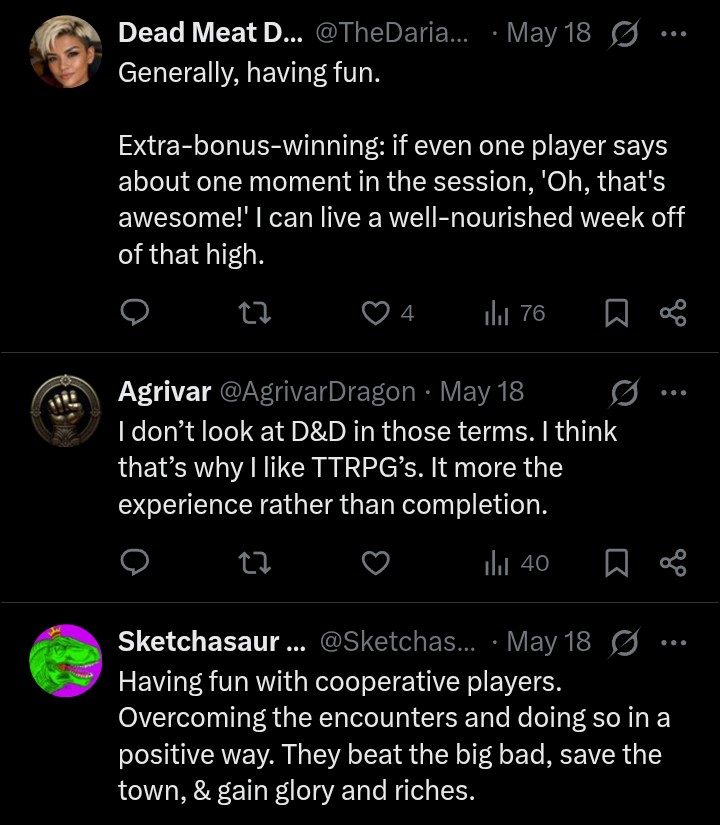
This gets trotted out every single time you try to have a serious conversation about how to elevate play. For reasons that had escaped me for years, RPG hobbyists had decided that fun and winning are self‑evident truths requiring no elaboration.
Fortunately, RuleOfThule’s post on the catastrophic misuse of self‑descriptive terminology (SDT) finally gives me the perfect lens through which to examine this beloved platitude. It isn’t pretty, but it’s important not to turn away from the intellectual ugliness.
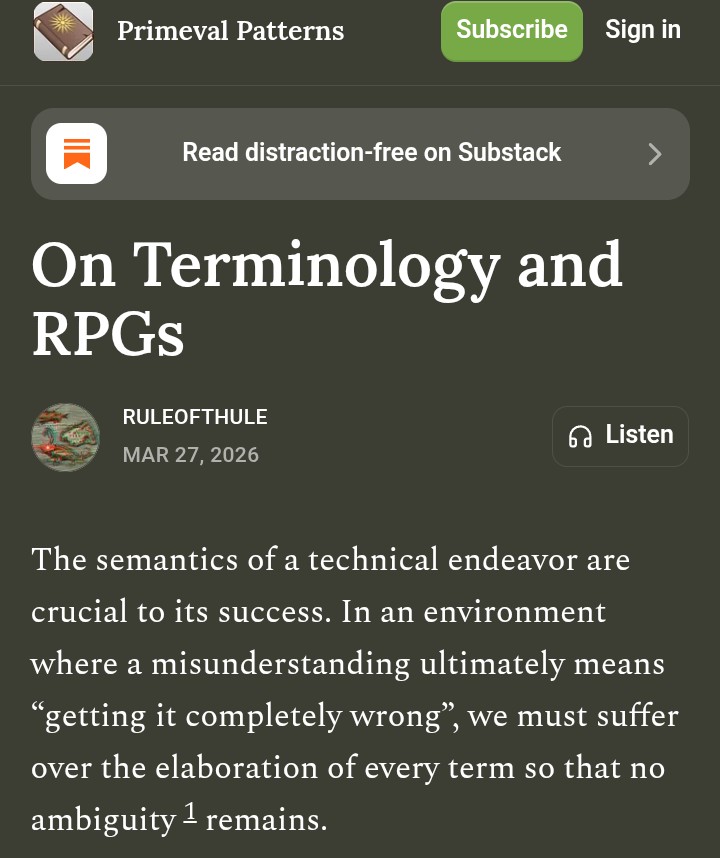
Let’s begin with fun, a term so vague it could describe anything from a gripping tactical engagement to a player giggling because they named their bard character “Bard Pitt”. Fun is the ultimate SDT term: it sounds like it explains itself, and therefore explains nothing.
Ask ten players what “fun” means and you’ll get twelve answers, all mutually exclusive. Some people think fun is solving a puzzle. Others think fun is avoiding puzzles. Some think fun is character immersion. Others think fun is derailing the campaign with a shopping episode. And a few think fun is watching the GM slowly lose the will to live.
But because the term is self‑descriptive, everyone assumes their personal definition is universal. This is precisely the SDT failure mode RuleOfThule warns about when he notes that SDT collapses under “rich characteristics” and “complex second‑ and third‑order effects.” RPGs are nothing but those.
Then we have winning, a term that in the context of RPGs has all the structural integrity of a wet cereal box. What does it mean to “win” a cooperative, open‑ended, non‑zero‑sum activity? Does it mean completing a quest? Mere survival? Achieving your character’s goals? Achieving the GM’s goals? Achieving no goals but feeling good about it?
Or perhaps, as the platitude suggests, “winning” simply means “having fun,” which means that fun means winning and winning means fun, and we’ve built a conceptual Möbius strip out of two words that were supposed to clarify something.
Which circles us back, appropriately enough, to the exact circularity RuleOfThule identifies in the evolution of hit points, where damage is defined by hits and hits are defined by damage. Congratulations: the hobby’s favorite motivational slogan is just as structurally sound.
The real genius of the phrase “As long as you’re having fun, you’re winning at RPGs” is that it is impossible to disagree with. Not because it’s profound, but because it’s baby poopytalk. It means nothing and signifies nothing. It is the verbal equivalent of a participation trophy.
This is the kind of conceptual sludge that SDT produces, and it’s been the dominant methodology to understand the hobby almost from the beginning. As RuleOfThule notes, SDT terms are vulnerable to motivated reasoning. If “fun” is whatever I say it is, and “winning” is whatever I need it to be, then any criticism of my playstyle, campaign structure, or design philosophy can be dismissed with a smug smile and a gentle pat on the head.
Why engage with the technical realities of RPG structure when you can simply declare victory by fiat?
It’s the difference between the hobby of feeling good versus the hobby of doing something.
Now compare this to what happens in a game that meets the definition of a Braunstein. “Fun” may occur in a Braunstein, but it is not the measure of one. “Winning” may occur, but only in the sense that one actor’s position improves relative to others within a defined conflict space, and not because everyone at the table smiled.
The phrase “As long as you’re having fun, you’re winning at RPGs” is a perfect example of why SDT has crippled RPG discourse. It is a slogan built from two hollow terms, each pretending to be self‑explanatory while actually being infinitely malleable.
RuleOfThule is correct: without precise terminology, the hobby collapses into nonsense. And nowhere is that collapse more evident than in the comforting but meaningless assurance that fun =winning.
If the RPG hobby wants to grow beyond the Getalong Gang’s warm tubfull of ambiguity, it must consign this phrase to the dustbin of history and embrace terminology that actually describes something.
Until then, the only thing anyone is “winning” is the race to say nothing with the greatest confidence.