

With the advent of the 11th Edition of Warhammer 40k, a lot of YouTube content creators are abandoning ship, and Mordian Glory observed in a recentish video that GW’s stewardship of the game continues to sever ties with the past. Not necessarily from a lore perspective, but from a game and/or mechanical perspective.
Now, I don’t play the game, so I can’t speak to that, but what I can do is look at the lore itself and point out a few connections that have been severed that the 40k fans probably didn’t notice.
When Warhammer 40,000 was born in 1987 (depending on how you count it), it was midwifed by a British sort of pessimism. Britain in the 1980s as a land where the empire had largely disappeared, industrial decline was reshaping life for the middle-class, and the certainties of Britain’s former position in the world were fracturing. The country remained powerful, but it was no longer the power it had once been. So too with the Empire of Man. In the future both grim and dark, humanity once possessed a glorious civilisation, but those days were over now and nobody is quite sure what to do other than fight for the sake of fighting.
The modern setting retains this pessimism, but its emphasis has shifted.
The Imperium is still decaying. Its institutions remain corrupt, its religious authorities remain reactionary, and its bureaucracy remains a monument to the triumph of procedure over purpose. But contemporary Warhammer – now under the control of very different people living in a very different age – now asks a very different question.
What if the decline can be reversed?
The man who used to be everybody’s least favorite Mary Sue, Roboute Guilliman, has grown over the past decade of lore development. Awakening after ten thousand years, he found to his chagrin that the civilisation he helped build has become almost unrecognisable. Instead of merely lamenting its condition, he attempts to reform it. The Indomitus Crusade, the introduction of the Primaris Space Marines and his efforts to reorganise Imperial government all suggest a hope for a brighter the future for the setting’s good guys.
Us.
Consider the Primarch for a moment: He’s a competent adult in a galaxy of lunatics. He actually cares about ordinary humans. He’s more nuanced than his reputation suggests.
Sound like anybody you know making headlines these days?
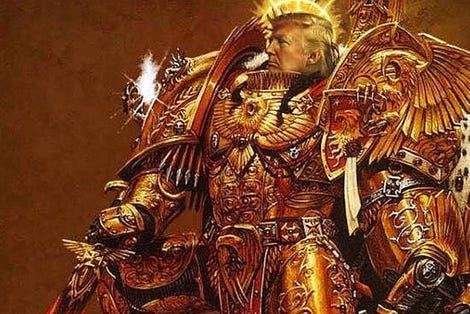
The people making this stuff don’t realize it any more than the proverbial finish doesn’t realize that it’s proverbially wet. There’s a subtle but very important change at work here. The original nightmare was that civilisation had declined beyond recovery. The modern nightmare is that civilisation might be recoverable, but that its own institutions will prevent the necessary changes.
The contemporary world has new reasons to be suspicious of institutions. Governments struggle with long-term problems, public services are swamped with foreign agents committing fraud to generate funds to their homeland, the systems built on a foundation of public trust and low time preference are overwhelmed by ethnic tribalism and high time preference parasites who think themselves clever for killing the host that feeds them, and with political systems becoming increasingly polarised in the wake of mass ethnic mobility, organisations of enormous size are becoming increasingly resistant to correction.
The problem is not necessarily that civilisation has lost all its knowledge or that its golden age lies irretrievably in the past. It is that the momentum of the machinery of society can propel it forward for a long time even as it fails to deliver the results it was designed to achieve.
Warhammer scales this up a million-fold. The Imperium possesses technologies capable of crossing the galaxy, yet struggles to administer its own territory. It commands superhuman warriors, but cannot escape the political and religious structures that make its wars endless. It has the resources of a million worlds and still seems unable to imagine a future beyond the next emergency.
Guilliman represents the fantasy that competence might make a difference. Someone understands the problem, knows how the system is supposed to work, and has the authority to do something about it.
But even he cannot simply start again. The institutions he wants to reform are also the ones he trusts, have a proven track record of over ten millenia, and the ones keeping humanity alive. Trust is a very fragile thing. Pull them apart too quickly and the whole edifice may collapse. The tragedy is that the system needs to change, but changing it may destroy the system.
I would not claim that Games Workshop’s writers consciously intend Guilliman as an allegory for the anxieties of the twenty-first century. Warhammer has always been an unruly mixture of satire, pastiche and spectacle. But the changing emphasis is revealing. The return of the Primarch introduces something the original setting could scarcely contemplate: the possibility that the decline might be reversed. The introduction of hope into a universe so long without it may have scared off some long time fans, but I’m fascinated by what it says about my people as a whole and how they view the world.
Hope, like trust, is a powerful thing, and its addition to the universe makes me curious to see what the next forty years of 40k might bring.