
Christopher, over at the The Tactical Tabletop has written a nice little mass battle fantasy wargame called Fights of Fantasy and was kind enough to send me a review copy. There are a couple of videos on the game over on the Tubes*, but for the readers out there, let’s do some writing on the matter.
*That’s not a link to my channel, by the way. Around here, we’re all about sharing the love. Unlike some channels about Daddy Fumbling – one of the more apt channel titles out there – who talk a big game about credit where it’s due but never seem to have the time to credit other channels, particularly when it comes to paying back those who pimped them as they were coming up the ranks but I digress. This is about Fights of Fantasy.
I’m not crazy about the core resolution mechanic. It’s an opposed roll d20 based game, which works well enough at the 1:1 scale, but really breaks down when you have rank and flank units on the table. Two 20-man units going toe to toe with a ten man frontage means you’ve got to roll ten matched pairs of dice. It’s a lot to track when you’ve got a hundred figures on the table. The dice pool mechanic of rolling ten to hit, ten to save, ten to wound sort of game flows better.
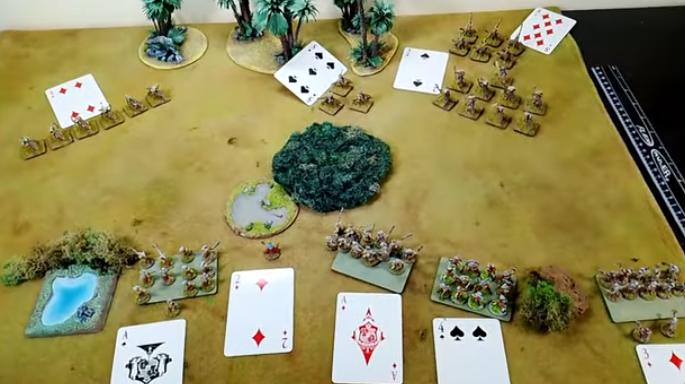
That aside, the game has one of the most interesting activation mechanics that I’ve seen around these parts. It’s chit based, but as you can see I’ve gone for cards. Two cards per unit, numbered sequentially, means a deck twice as big as your forces. Take two armies of five units each for a total of ten units. That means you’ve got chits numbered from 1 to 20. You take turns drawing the chits out one at a time, and have to place them on your own units as they are drawn.
This set-up leads to a couple of little mini-games within the activation phase:
- For one, you’ve got a push-your-luck thing going where you might want to play that 3 on a unit to make it go first, but if you know the 1 and 2 are still in the bag…do you wait? And hope your opponent doesn’t draw a lower number? You might not even draw a lower number and your last draw might be the worst possible result.
- There’s an element of not showing your hand too fast. As the chits get played, your options narrow, and your opponent’s ability to react increases. There’s room for bluffing in here, but as a solo guy, I can’t say much more than that.
Certain spells and abilities will allow an extra draw which gives you a little more control over things, but let’s focus on the core mechanic first. Once the chits are played, you work through each phase of the Four-Ms in that order (magic, movement, missile, and melee). This is where things get really interesting, and it feeds back into the initiative phase in some challenging ways.
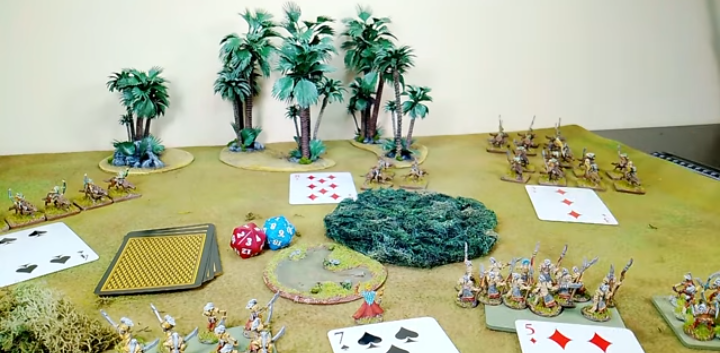
You might want your wizard to lay the hate early, but move out of the way late. You can’t do both. Because all spells pop in the chit order, and all movement happens in the chit order, too. You can’t cast early and move late. It can make for some interesting conundrums, especially when it comes to charging into combat. You want your opponent to move first, so you get the charge bonus, but that means that when the melee phase comes around you’re resolving the combat later than you might want. He might be able to bring allies into the fray on a follow-up move before your knights have fully struck home.
Good stuff, supplemented by one of the most robust army building systems I’ve seen. The game is a stat-line game with maybe three or four traits/keywords you can plug in. You’ve got about six variables you can tweak to generate everything from swarms of teeny shooters to hulking melee brutes, and when you add in weapon and armor types you’re going to be hard pressed to find a figure that you can’t stat.
Despite my misgivings about combat, the game comes highly recommended. The activation system is just that good. One of these days I’m going to bolt it whole-cloth onto a game of One Page Rules and solve a lot of that games’ problems.
One other downside, you can only get it from the spiteful monsters over at the vault. Here’s a link. I feel dirty.