

Time to shrink the bucket list by getting DemonLord, a free print-and-play hex-and-counter wargame on the table. This is one of those games that showed up on the game store shelf decades ago, but five to ten bucks was too much for tweenage me. Then it showed up on the internet as a free download at Dwarfstar Games, and other things just kept bumping it down the queue.
It has languished on the dance card long enough. I’m not getting any younger, so it’s time to see how well this game plays. The other Dwarfstar games have been a lot of fun, so there’s no reason to expect this won’t be as well. After a first read through of the short 24-page rulebook, it already shows a lot of promise.
The original artwork is lovely, and the counters a good mix of colors and busywork, but the scans of the original work aren’t well suited to modern day printers. Luckily for me, a random fan named Lovinski has lovingly remastered them all, and it is these that you’ll be seeing on my table.
The map puts the good guys in the grasslands to the west, and the bad guys in the mountains, desert, and steppes to the east. To that, the author Arnold Hendrick has scattered neutral factions to the north, southwest, and right smack between the two factions.

Mo9vement about the map features an unusual rule: you don’t look at the terrain in the hex you’re moving into, you look at the terrain along the hex side you’re trying to cross. You can pick which route to take, meaning in the example below you could move from hex 1104 to 1105 via the hills (orange), the woods (green), or plains (pale green). The usual movement and combat penalties apply, but we’ll talk about combat a bit later.

First, let’s look at the counters. The good guys, Hosar, are in pale yellow, and the bad guys, the eponymous demon forces, in purple. In addition to the standard combat and morale and movement factors, the weapon type and armor type are indicated by the icons. Black icons are heavily armored, outlines factions are medium, and white icons are unarmored. Add to that an indication of foot, cavalry, or winged (in the upper left corner) and these counters are dense with information.
The game includes black spell tokens and characters. Lord Nish here brings spell power, a +2 boost to morale and combat, and can run around the map pretty fast with that 7MP. He runs the risk of being captured if caught by a unit counter, which is an interesting way to invoke that Tolkeinian feeling of heroes racing to be in the right place at the right time to make a difference in battles.

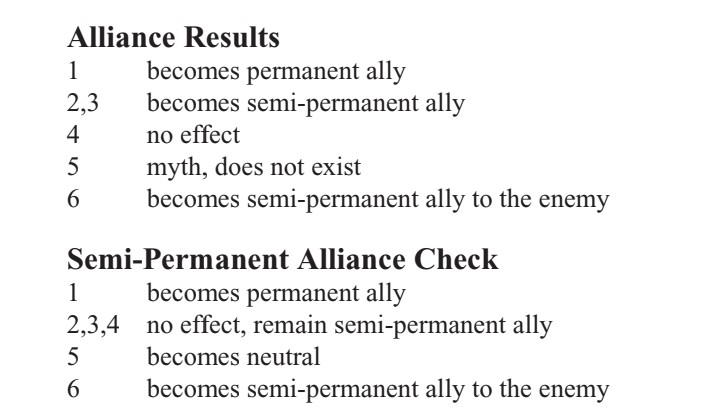
In the example above, the green and blue counters are for the neutral factions, which might ally with either side of play. The introduction of political alliances in so compact a game is fascinating. It suggests a level of replayability that punches well above its Ziploced weight. It’s also worth noting that there is a chance that these factions don’t even exist. You won’t know until you dispatch a character to sweet talk the faction and roll on the following chart. Some of the factions have multiple options as well; the Mines of Ula might house an independent demon with ogres and slaves, or the dwarf faction – only one of which can be in the game. Their power levels are about the same, but the way they handle is very different, adding a sense of mystery and uncertainty to the proceedings.
But when it comes to fighting battles, it’s not a simple roll off. Firs off, getting back tot he multiple terrain types in a hex, when a fight breaks out the defender chooses the terrain type. You could march in through the woods, but have to fight on the plains. Why does that matter? Well, you have to see how battles are fought first. When two stacks of units meet, you place matched pairs of units, with extras serving to provide two-on-one fights, but only if there is sufficient room. You can only have a four units fight in the swamps, eight in the countryside, and twelve in the steppelands. Anybody that doesn’t fit into that band has to sit back as reinforcements. Then you place characters to support combats, and as units are destroyed or routed, you can redeploy, giving fights a suitably tactical feeling.
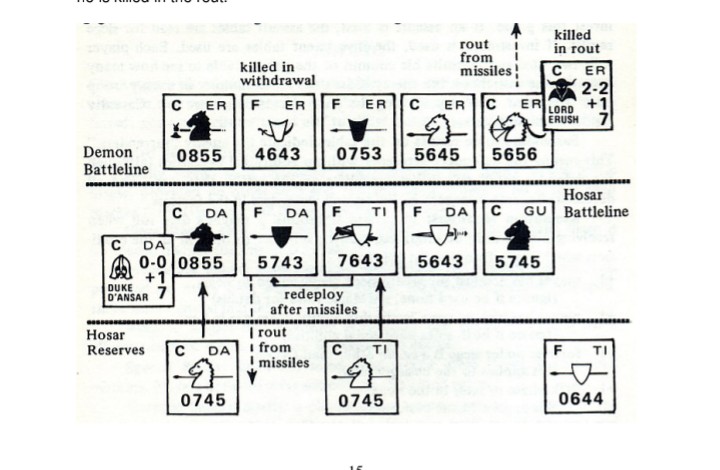 Units that rout will rejoin your army if you win, or might wind up captured if you don’t, leading to prisoner exchanges to prolong the game. You can bail on a fight at any time, but have to race back to the nearest friendly fortress that isn’t under siege.
