
In my last post I took a stab at identifying the different archetypes of Braunstein players. It’s a loose taxonomy, and more a shorthand for understanding the major strategies at play in the game. Today, let’s take a look at the session Braunstein’s themselves. Not the overall campaign style Braunstein, but the bottle episodes that happen in an afternoon.
I’ve broken them down into Seven Categories, but this is a rough first stab at it, and some of these might deserve to be broken up or merged, and there may be some I’m missing. Backcheck me on this, people. This style of play might be older than role-playing games themselves, but the serious scholarship is still in its infancy.
The Political Braunstein
The primordial form, the one David Wesely stumbled into when he handed out role cards in the town of Braunstein. A mayor, a student radical, a general, a banker – each with their own goals, each convinced they are the protagonist. The party-haul or big social event Braunstein’s, like the Red Kegger, would also fall under this category.
The Political Braunstein thrives in dense human environments. Cities. Courts. Guildhalls. Every conversation is a battlefield. Every handshake hides a dagger. The referee’s job is not to shepherd players through a plot, but to adjudicate the consequences of their schemes colliding in real time.
The Military Braunstein
The Political Braunstein deals in whispers, the Military Braunstein draws cold steel. Armies on the march. Supply lines stretched thin. Orders written in haste and delivered too late. This is the Braunstein as wargame—Arneson’s true inheritance. Operation Muscle Thunder serves as the first and still unbeaten champ of this category…at least that I know of.
Modern examples like Moonstein and Spacestein show how potent this form remains. Give players command of forces, deny them perfect information, and watch the world catch fire. The referee becomes a dispatcher of battlefield reports, a neutral arbiter of fog‑shrouded maneuvers.
The beauty of the Military Braunstein is that it reveals character through action. Nothing exposes a player’s soul like the moment they decide whether to retreat, reinforce, or burn everything behind them.
 The Domain Braunstein
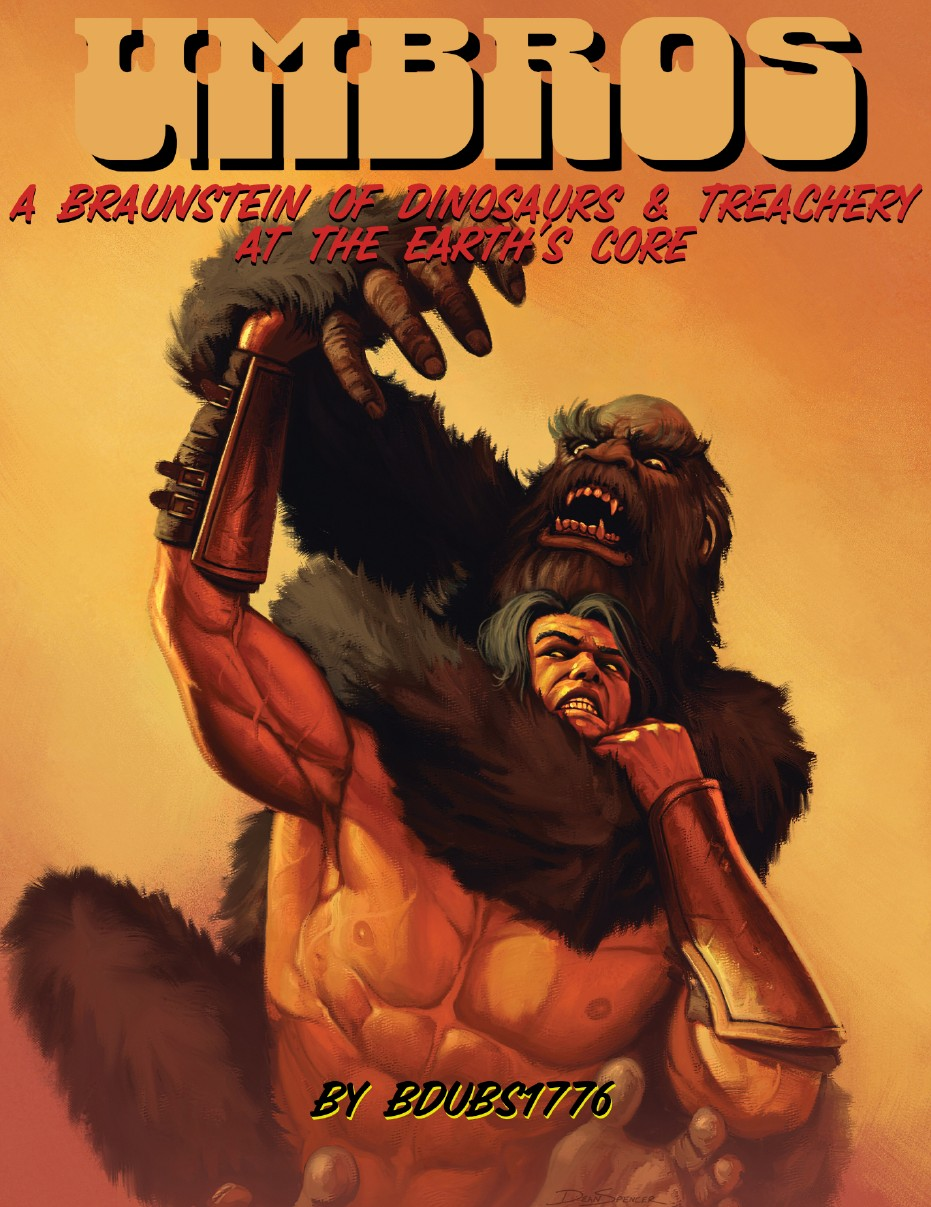
Once players control land, troops, or institutions, the game ascends into the strategic layer. Diplomacy, espionage, economics—these become the tools of play. The referee adjudicates weeks or months of activity in a single turn. Dubzaron’s domain wars, as seen in UMBROS and the Destruction of Drakonheim are the seminal examples of this style of play.
Here, players maneuver like medieval princes, each convinced the world is theirs to shape. Alliances form and shatter. Armies march. Fortunes rise and fall.
The Domain Braunstein is where the campaign becomes history.
The Exploration Braunstein
Some frontiers are political. Some are military. But some are simply unknown.
The Exploration Braunstein sends multiple expeditions into uncharted territory—whether that’s a wilderness hex‑crawl or a Traveller subsector. The tension comes from scarcity: limited time, limited supplies, limited knowledge. Every decision is a gamble. I don’t know if anyone has done this yet, but whispers on the wind suggest one is coming.
This archetype rewards curiosity and punishes complacency. It is the purest expression of the human urge to push beyond the map’s edge.
The Crisis Braunstein
Sometimes the world doesn’t simmer. It explodes. Again we look to Bdubds and the Shuckstein for example of a single, high‑stakes event: a coup, a festival, a riot, a battle. He calls the Schuckstein a battle braunstein, but given the investigatory nature of the crisis, I just don’t think that’s appropriate. Either way, this one happens when all actors converge and all agendas collide in a single chaotic mess. The referee’s job is to keep the plates spinning as the players race to achieve their goals before the situation resolves.
These are perfect for one‑shots or convention play. They burn bright and fast, leaving behind a trail of legends.
The Godstein
Harmony Ginger gave us the name, and the first on-purpose example, but the pattern has been with us since the beginning, when the BROSR accidentally turned the demigods of Brovenloft loose. The Godstein is the Braunstein elevated to the mythic scale. Players act as gods, demigods, or archetypal forces. Their moves reshape the cosmology. Their conflicts echo across ages.
This is where Primeval Patterns’ symbolic logic meets the Braunstein’s emergent dynamism. The world becomes a myth‑generator, and the players become its authors. The Godstein reminds us that the Braunstein is more than a game. It is a way of understanding how stories arise from the interplay of wills.
The Adventure Braunstein
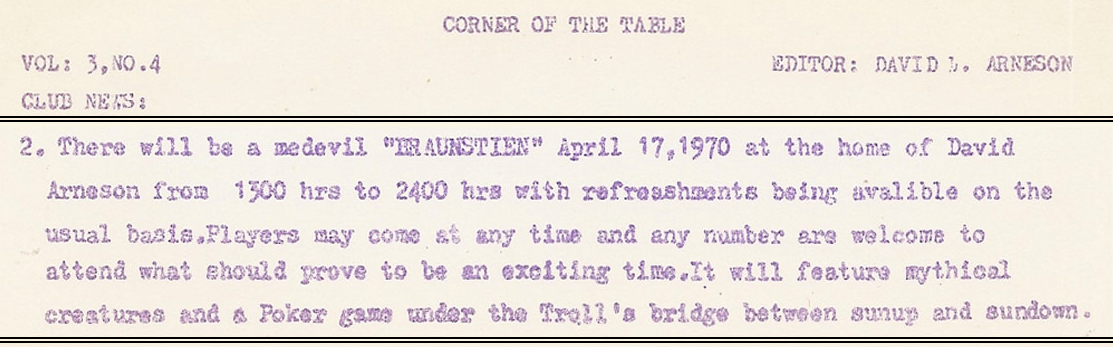
This is the form most recognizable to D&D players, though rarely practiced as intended, and honestly I’m not sure anyone has run one of these since Dave Arneson ran the first medieval Braunstein in a little place you may have heard of call Blackmoor.
In an Adventure Braunstein, the players are not a party in what has unfortunately become the usual sense. They are independent agents. Rivals. Opportunists. The dungeon becomes a crucible where ambitions collide. Fluid the Druid’s has quietly been playing this style on his own for five years, to little fanfare: adventurers racing each other into the dark, patrons sending hirelings to snatch treasure before anyone else can reach it, thieves running workhouse scams, and so on.
This is the dungeon and session play as competitive frontier, not cooperative story hour.
Of course, sometimes you can run a Braunstein and just let nature take its course. Livingstone, the wild-west shoot-em-up started as Political, but turned into a Crisis because as always, the players get a vote, too. Then there is DM Raptor’s War For the North which is billed sometimes as Battle and sometimes as Adventure. You tell me, which one is it?
These seven archetypes are the shapes the chaos takes. The signals within the noise. Start to look for them in your own games, and you’ll be a leg up on the competition. Start to look for them in the AARs, and you’ll notice the crown forged by the old masters and left rotting in the gutter for fifty years – not jsut a set of rules, but a living world where human ambition, in all its forms, can play itself out.
This post has been, and will be, edited to add more examples and links. Thank you to all my friends who supplied them. There’s just too many for me to keep track of them all these days.