

Rule Zero continues to poison the well of tabletop RPGs. Let’s use a little Game Theory to understand the how and why.
The Prisoner’s Dilemma is a classic model from Game Theory that illustrates how individually rational decisions can lead to collectively worse outcomes. Bear with me if you’re already familiar with this – we need to establish our nomenclature. The standard formulation is that two prisoners are arrested and interrogated separately. Each has two choices. He can Cooperate or Defect:
- If both Cooperate, they each get a light sentence.
- If one Defects while the other Cooperates, the defector goes free and the cooperator gets a heavy sentence.
- If both Defect, they both get a moderate sentence—worse than mutual cooperation.
Over repeated iterations of this exercise, individually rational behavior leads to a collectively inferior equilibrium. This isn’t just a theory, it has plenty of real-world applications from the Welfare State to Peace Treaties to Littering, and so many other subjects less important than tabletop gaming. The Prisoner’s Dilemma is a social game that is ultimately about trust, risk, and the tension between individual rationality and collective optimality. It’s an easily understood way to understand why cooperation is hard, and why it’s so valuable when achieved.
So let’s use it to look at TTRPGs.
Players (including the one nominated to serve as neutral referee, regardless of what you call him) sit down together to build a shared world, compete against each other, produce the events that create memorable stories, and navigate the challenges inherent in using a ruleset everyone has agreed to follow. Beneath the dice rolls and character sheets lies a subtle strategic tension: should you follow the rules exactly as written (RAW), or allow the referee to override them with Rule Zero?
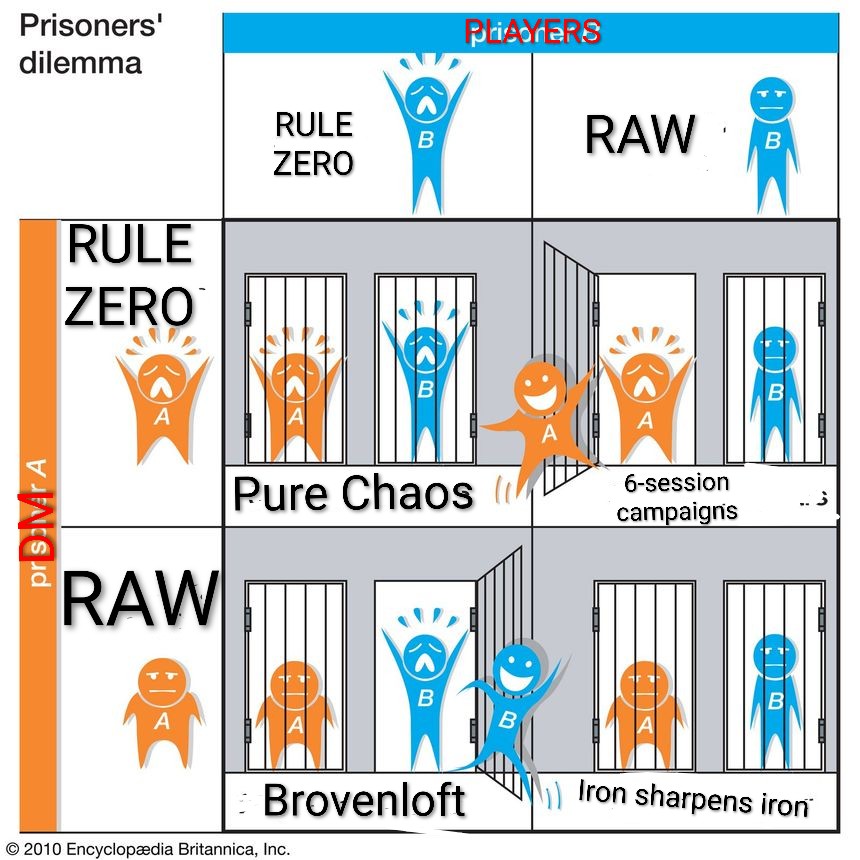
If you frame an ongoing campaign as an iterated Prisoner’s Dilemma, each session is a repeated round. Each participant chooses between cooperation with the rules (following RAW) and defection from them (invoking Rule Zero). And just like in the classic dilemma, the long-term health of the group depends on how these choices evolve over time.
In the classic framing of the dilemma, each participant optimizes for his own payoff. But when you put things in the proper order as defined by Gygax (read: rules > campaign > players) the payoff structure changes. The shared strategic framework – the ruleset everyone agreed to – is the thing whose long-term benefit we want to maximize. That means the goal is no longer “avoid exploitation”, but to maximize the stability, clarity, and usefulness of the framework across many iterations. This produces the long-term stable campaigns from which the stuff of legends is born.
Now the Prisoner’s Dilemma predicts that the best long-term outcome is mutual cooperation, i.e., everyone consistently relying on RAW as the shared framework.
Here’s why.
The value of RAW isn’t merely that it tells you what happens mechanically. It creates common knowledge. Players can make meaningful decisions because they trust that the published rules, not someone’s changing judgment, will determine outcomes. That predictability allows planning, informed risk-taking, and a stable social contract.
And that’s the heart of it. A campaign isn’t held together by clever rulings or moment‑to‑moment improvisation. It’s held together by the shared confidence that the game everyone sat down to play is the game everyone is still playing. RAW gives you that confidence. It gives you the stable equilibrium that long‑term play demands. It creates a distance between player and game that allows for events and strategies within the game that are unthinkable to mainstream players. It gives you the cooperation that makes trust possible, and the trust that makes strategy meaningful. Ironically, it creates a place with sufficient trust among players to allow for distrust among characters.
Rule Zero can’t do that. It can only replace cooperation with conditional obedience. It can only turn a shared framework into a shifting target. It can only teach players that the rules matter until they don’t. And once that lesson sinks in, the campaign’s stability is already compromised. The well is already poisoned.
If you want a campaign that grows, deepens, and becomes the kind of story people talk about years later, you need a framework that everyone can rely on. You need rules that mean what they say. You need cooperation that doesn’t evaporate the moment it becomes inconvenient. You need a system where trust isn’t optional.
So yes, let’s use a little Game Theory. Let’s take the lesson seriously. Cooperation with the rules by everyone at the table, digital or meatspace, produces the strongest long‑term outcomes because everyone commits to the same framework. That’s how you get campaigns that endure. That’s how you get stories worth remembering. That’s how you get the most out of your games.
—
As a post-script, there is only one real example of a campaign that lives in the bottom-left quadrant of that graphic. Back in October 2022 the BROSR ran an experiment which, in retrospect, saw the players using Rule Zero thanks to a heavy influx of wish spells, and a harried DM trying to adjudicate the resulting nightmare using the rules as written.
Walker’s Retreat: My Life As A Gamer: #BROvenloft Begins
The result was a month-long epic confrontation between elemental forces of good and evil, whose tale has only grown in the retelling. It was also the candle that burned too bright and thus too short. No DM can handle that kind of pressure for long. (Though Kestutis Kalvaitus managed to bear the burden longer than anyone had any right to expect.) It’s a very strange way to run a game, but it’s one that owes much to the pre-Gygax version of wargaming. A few miniature wargamers have done some work on it, but they haven’t really considered campaigns of this nature through the RAW/Rule Zero analytical lens. They don’t think in those terms. As to the TTRPG crowd? It’s just not a very marketable scam to run on the rubes, so it hasn’t seen much in the way of investigation or scholarship in those realms.