

“In the realm of RPG discussion, it is evident that the prevailing body of terminology serves to confuse rather than to clarify.”
Perhaps nowhere is this more true than in discussions relating to GM authority. The two main camps have been divided into “Rule Zero” and “Rules as Written”, with the usual fence-sitters occupying various shades of middle-ground between those two banners. The team that loves the boot of the GM on their faces forever have slogans such as “the DM is always right,” or “rulings, not rules,” and “but the 5e DMG says nothing matters so I can do what I want and players can go pound sand if they don’t like it.”
(You can guess which camp I fall into from the way I framed that last sentence. I apologize for nothing.)
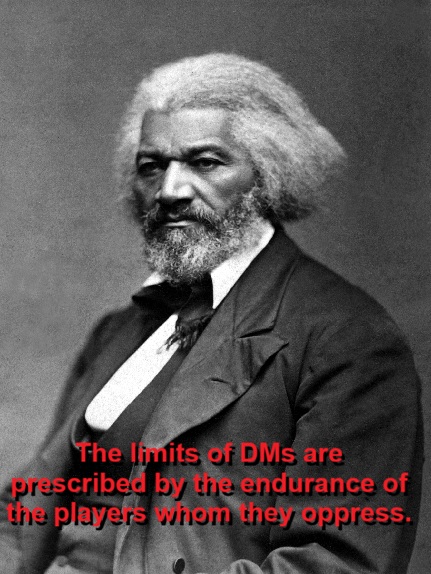
Regardless of where you stand on the matter, those phrases blur together several very different kinds of authority to create a suitable smokescreen from which the bad actors are free to maneuver. They ask bad faith questions – admittedly as often out of ignorance as out of malice – and conflate a number of different kinds of decisions that a GM makes.
Clearing the air is a simple matter of separating the kinds of decisions a DM makes. Once we do that, the issues become much clearer.
A DM can exercise three distinct forms of authority:
Interpretive Authority is the ability to resolve ambiguity. Rules are written by humans, and humans sometimes write unclear rules. When reasonable people can read the same paragraph and reach different conclusions, someone must decide how that rule applies at the table.
Residual Authority is the ability to resolve situations the rules never anticipated. No RPG can cover every possible action. Eventually a player will attempt something the rulebook simply doesn’t address. The DM fills that gap with a ruling that allows play to continue.
Legislative Authority: the ability to ignore, suspend, or rewrite an otherwise clear rule.
Many players assume that because a GM interprets unclear rules and creates rulings where the rules are silent, the DM must therefore also possess the authority to disregard any rule whenever they believe it would improve the game.
That conclusion does not follow.
The first two authorities are lubricants that allow smooth play of the limitless “you can try anything you can think of” style of gaming that are the central appeal of RPGs. The third is a separate power altogether.
Once we distinguish these authorities, a straightforward decision process emerges.
Step One: If the rules are clear, apply them.
This is the foundation of impartial play. A clear rule should produce a predictable outcome regardless of whether the result benefits or harms any particular player.
Step Two: If the rules are ambiguous, interpret them.
Sometimes two reasonable readings exist. The GM’s role is to determine which interpretation best fits the text and the rest of the rules. This is not changing the rules; it is deciding what they mean.
Step Three: If the rules are silent, make a ruling.
When the rulebook simply has no answer, the GM exercises Residual Authority. Ideally, the ruling should be consistent with the existing mechanics and principles of the game so that it feels like a natural extension of the rules rather than an arbitrary invention.
Step Four: Never disregard a clear rule because you dislike the outcome.
If a written rule produces an undesirable result, finish the session using the rule as written. If the group later decides the rules do not work for them, they can find another mutually agreeable ruleset to use. At the very limit of this step, a table can opt to create a houserule I guess if you have to, but that’s a camel’s nose in the tent you’re better off avoiding given the undefeated nature of the slippery slope.
This distinction changes the role of the GM.
Under this model, the GM fulfills his original role as impartial arbiter rather than benevolent (sic) monarch, a heavy-handed and omnipotent storyteller, or a divine authority whose judgment supersedes the players and the rulebook.
Think of a sports referee. The referee interprets unclear situations. They resolve plays that happen too quickly for the written rules to anticipate in perfect detail. They make judgment calls. What they do not do is decide that offside no longer exists because allowing a goal would make for a more exciting ending.
Their legitimacy depends on applying the rules consistently rather than producing a preferred outcome.
The same principle applies to RPGs.
Players can only make meaningful strategic decisions if they believe the rules governing those decisions will remain stable. If a successful tactic can be invalidated simply because the GM dislikes the outcome, then players are no longer planning around the game – they are planning around the DM.
That uncertainty weakens player agency.
Conversely, when players know that clear rules will be applied consistently, they can develop strategies, negotiate alliances, manage risks, and make long-term plans with confidence.
This becomes especially important in campaigns featuring player-driven factions or meaningful player-versus-player conflict. In boring and mainstream cooperative campaigns, the occasional improvisation in the name of narrative has no affect on trust because who cares about that when everyone is just there to enjoy the GM’s pretty hallway.
In a normal campaign, however, neutrality becomes part of the game’s infrastructure.
If two player factions are competing for territory, wealth, influence, or political power, every ruling has the potential to advantage one side over another. Even a well-intentioned decision to ignore a written rule “for a better story”, whatever that means, can create the appearance of favoritism.
A consistent process avoids that problem.
Players know that the GM will first apply clear rules, then interpret ambiguity, then fill genuine gaps – and only those gaps. The outcome may not always favor them, but they can trust that it was reached through a predictable process rather than personal preference.
Ironically, limiting Legislative Authority often strengthens the GM’s authority where it matters most. When players know the DM is not free to alter the rules whenever convenient, they are far more likely to accept difficult rulings and unfavorable outcomes. The GM earns and maintains his credibility not by possessing unlimited power, but by exercising disciplined restraint.
But we began this post by talking about the weaponized ambiguity of RPG terminology, so let’s tie this back into that discussion.
The heart of the problem, as RPG terminology so often demonstrates, is that vague language enables vague power. When players and GMs lump every kind of decision under the banner of “Rule Zero,” they create exactly the conceptual fog that lets overreach masquerade as expertise. By separating the GM’s authority into the realms of Interpretive, Residual, and Legislative, we strip away that fog. Each authority becomes a clearly defined tool rather than a catch‑all justification. The GM is no longer a figure whose decisions derive from personal preference or narrative whim, but from identifiable categories of responsibility that everyone at the table can understand.
Once those categories are clear, the conversation about GM authority becomes far less mystical and far more practical. A GM who applies rules consistently, interprets ambiguity faithfully, and fills genuine gaps earns trust precisely because their authority has boundaries. That trust is what makes strategic play possible, what keeps factional conflict fair, and what prevents “rulings, not rules” from becoming a bludgeon wielded by bad faith GMs who want to keep the monkeys on the other side of the screen dancing to his own tune.
If the hobby is ever going to escape the endless spiral of bad arguments about GM authority, we have to stop treating “Rule Zero” as if it describes a coherent position. It doesn’t. The only way forward is to retire the fog‑machine vocabulary and start using distinctions that actually map to the decisions a GM makes. What I’ve proposed here is the minimum conceptual toolkit required for honest discussion.