
Tomorrow’s War is one of those games that everyone remembers trying, and everyone has complaints about, but that never quite seems to go away. It’s a game that, in the fifteen or so years since publication, has mostly lurked in the corners of the hobby, but keeps popping up in random odd moments. Maybe it’s just me and my beloved sense of observer bias – I had some laughs with it and tend to notice any mention of the game.
If you’re unaware, it’s a near sci-fi – almost a hard sci-fi – miniature wargame that evolved out of the Ambush Alley and Force on Force rules, and it was published pretty early on in the Osprey’s expansion from sourcebooks to rulesets. It uses an interesting action-reaction system and emphasizes troop quality, orders of battle, and scenarios rather than stat lines, point costs, and long equipment lists. It has some rough edges and more mechanical chrome than it probably needs, and both of those are presented in the main rulebook intertwined with the core mechanics in a way that makes it hard to learn to play from the book. You really need an oldhead to walk you through the important bits – a design philosophy ruthlessly adopted by and practiced by the Lardbodies, you’ll note. Unlike their oeuvre, Tomorrow’s War is worth the lift. It gives you a more narrative outcome, and models near-future combat really well. As a result, the consensus is that despite its flaws, Tomorrow’s War is still worth playing.
So I’m gonna.
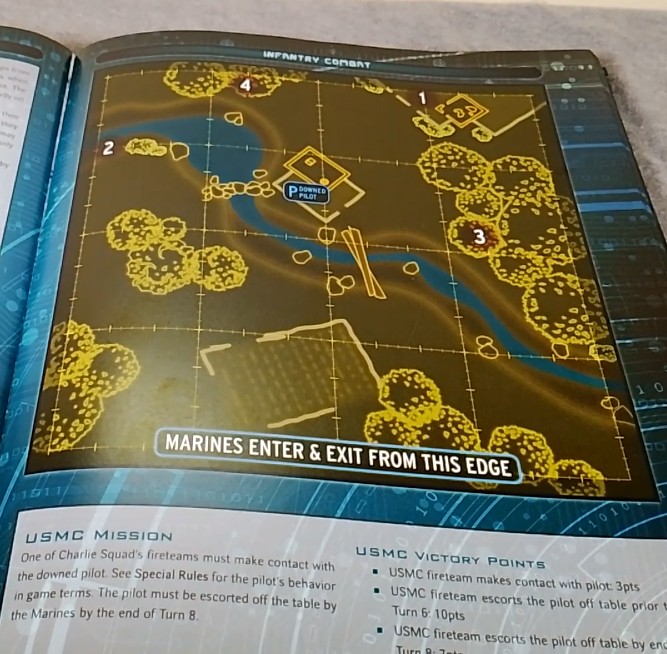
Once I get a game of Lost and Found, the tutorial scenario in the main rulebook, under my belt, I’m going to look to playing a few games stripped down to bare bones. In short, I’m going to build a real tutorial level. The goal is to reduce the cognitive load as much as possible outside of the core mechanics of initiative, activation, combat, and morale. Get those right and you can start to look at adding in the chrome, such as Tech Levels, Ambushes, Hidden Movement, Vehicles, Robots, and so on. Half of those are presented in the “easy” version of the rules and just confuse the issues.
To keep the asymmetric nature of the game front and center, we’ll go with a larger force of ill-trained troops and a smaller force of trained troops. This is the structure used in Lost and Found, and it’s a good one except that the balance in that scenario comes from implementing Tech Levels, Ambushes, and a very short Turn Counter. For my purposes, here’s a nice balanced pair of opposed forces. They all have standard assault rifles (unless otherwise noted) and heavy armor (2D), for the sake of consistency.
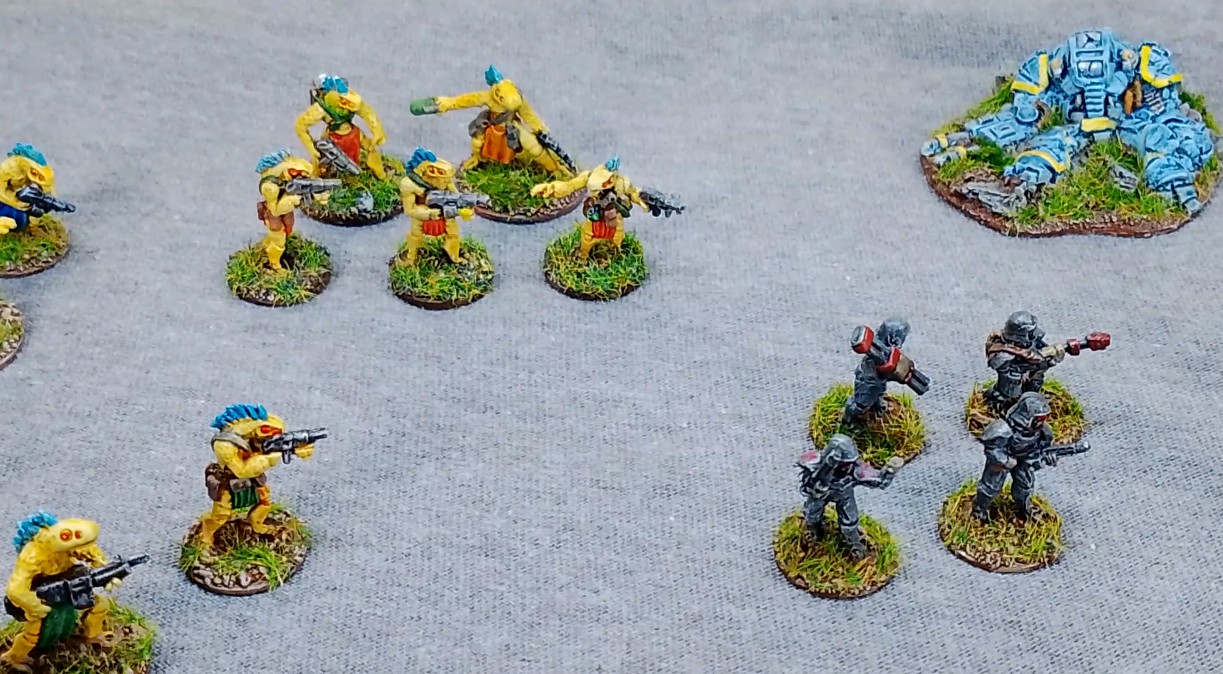
The Humans: Three fireteams of four models of troop quality d8. Each one consists of a fireteam leader, two riflemen, and a support weapon. Add a squad leader for some light morale effects, and you’re done.
The Aliens: Four squads of six models of troop quality d6. Each squad has a squad leader, four riflemen, and a support weapon. That’s nearly twice the figures and one more maneuver element, but throwing d6s will balance things out really well. That reduces the optimal range at which these units can fire, as well as their ability to react, seize initiative, and
Notice that this is almost exactly the structure of the tutorial level, but we’re going to simplify the experience. Skip the medic, so we only have to remember one casualty chart. Limit the support weapons to SAWs so you just have to remember to add one firepower die across the board. Forget the search and rescue aspect of the game, the semi-hidden deployment, and ability to attack from ambush. That last one isn’t well implemented anyway – given the size of the table and the 12-inch limitation on their optimal range, the hidden guys just aren’t close enough to take advantage of ambush.
We’re keeping the Fog of War cards, though. They add too much variability and surprise to the proceedings to do without. This will also help train our eyes and brains to look for those rolls of a 1 on the Reaction checks.
As for a scenario objective, make it easy, and make it one that encourages movement and suppression. I’m going to go with a break through scenario in which the d6 force has to get four figures from any one squad off the D8 player’s table edge. That gives the D6 player a very clear problem: pick a squad, move it toward the objective, and use the other three squads to create opportunities and absorb pressure. It also makes the D8 player’s superior troop quality immediately meaningful. They have fewer units, so they need to decide where their better troops can do the most damage. And they have to find a way to put broad-spectrum pressure across the full front, which will be made more difficult by the use of lots of line of sight blocking terrain. They’ll have to find those key fire lanes and try to withstand volleys from the enemy so they can keep those fire lanes shut down to movement.
I’ll let you know how it goes.