

One of the big stumbling blocks to implementing the BROSR methods of better RPG play is the heavy intellectual lift involved. You can gradually add in bits and pieces of Real D&D, but these systems are so intertwined that it will cause problems that can only be solved by adding in more BROSR techniques. It can feel like you’re playing whack-a-mole, with every change requiring other changes to make the whole system work. It can be discouraging for those who are used to being spoon-fed solutions to imaginary problems. As things stand, there still isn’t a single guiding document that makes it easy for top-of-the-bell-curve TTRPG players to overcome the high bar to entry, but that’s changing.
The boys in the Real D&D R&D Department are working around the clock to develop a unified approach to Better D&D, and to package it in a way that is more accessible to those who want to experience the best the hobby has to offer.
That’s been going on for a while now – and it’s always been a part of the BROSR mission – but it’s worth taking a step back and looking at how far this revolutionary approach to RPGs has come, and see if we can guess where it’s going to wind up.
For years the project was fundamentally argumentative. The bulk of TTRPG players are hidebound, conservative, and too set in their ways to listen to anyone who isn’t selling them pats on the head and attaboys for doing the things they’ve always done. They were not receptive to the BROSR’s examples of how things can be better nor of the BROSR’s tough-love approach to encouraging them to do better and be better. That pointless resistance led to a lot of unnecessary drama even as it elevated the visibility of this little project for a better gaming tomorrow.
Recent work has turned away from the ankle-biters and focused more on the question of how you actually run this thing?
The most revealing example is BDubs’ UMBROS campaign. It began as an experiment in Total Nonstop Braunstein and has increasingly become a laboratory for developing procedures that can be reused elsewhere. UMBROS combines conventional adventure play with faction-level play and downtime orders, allowing the campaign world to continue moving between dungeon sessions. BDubs reports that roughly 90% of the material appearing in his campaign chronicle originates in this downtime process:
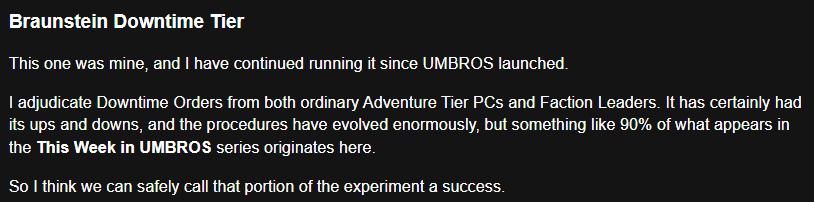
The problem, naturally, is that persistent agency creates an enormous administrative burden. If twenty, thirty, or forty players can independently act in a world, the referee becomes an information-processing bottleneck. The current consensus is that the answer involves a collection of related procedures: Docketing, GOSS, SEEN, downtime orders, scheduled adjudication, and controlled information propagation. Rather than having the DM invent what happens, players submit actions; procedures determine how those actions are resolved; SEEN determines what becomes observable; and the consequences feed back into the campaign. BDubs complements this process with the revolutionary role of the Booker, who steers the feedback in a way that allows the information and conflict to propagate among the multiple DMs running sessions.
That is a dramatic shift away from philosophy and to engineering. And the whole point of engineering is two-fold: stability and replicability.
Brief aside: For those on the leading edge of RPG innovation, the campaign has become the experiment. A procedure gets tried, breaks under pressure, gets modified, and gets tried again. The resulting knowledge is gradually being extracted from numerous campaigns so that it can be refined, condensed, and turned into reusable technique.
Which brings us directly to the commercial question: What Should Someone Actually Sell?
If this body of work becomes a product category, I think there are two obvious directions:
- Fully realized campaign settings: worlds designed specifically for persistent time, faction play, Braunsteins, domain politics, logistics, fog of war, and emergent narrative.
- Campaign infrastructure: tools that let a DM take an existing setting or a blank map, and turn it into a living campaign.
My prediction, for what it’s worth, is that the second has substantially greater long-term market potential. A setting sells a world, and what does and does not go into that setting will drive the consumer interest. Some people just don’t like elves. Some people, D&D5e players for example, just don’t like adventure. Some people just don’t like settings where you can free slaves. On the other hand, a toolkit sells a capability.
A DM might love Greyhawk, Forgotten Realms, Mystara, a homebrew setting, or a completely improvised hexmap, and he. He doesn’t necessarily want to replace that world.
But he may absolutely want a better way to handle campaign procedures such as:
- faction actions;
- downtime;
- NPC agendas;
- rumors;
- information leakage;
- domain activity;
- economic changes;
- wilderness travel;
- military conflicts;
- player orders;
- calendar advancement.
That’s a much larger addressable audience. They are looking for tools that amplify the creativity of players and DMs and Booker rather than details that compete with it.
This is why the current BROSR experimentation interests me more than the earlier polemics. We’ve spent years demonstrating that systems + incentives + independent actors + persistent time can generate extraordinary campaign situations. The recent work is about identifying the procedures that make that process manageable.
That suggests a product that looks less like a traditional RPG book and more like a campaign operating system.
That is a fundamentally different relationship between an RPG product and its referee. The product doesn’t replace the campaign. It makes a highly detailed campaign involving 50+ players capable of running.
And that, I suspect, is where the real commercial opportunity lies.
If the BROSR experiments can turn this insight into a genuinely usable, system-agnostic tool, it could ultimately have a much larger audience than a collection of beautifully realized BROSR-specific settings. Because products that are just another world to play in are a dime a dozen. But a product that serves as a machine for making the world move – despite the inputs of dozens and dozens of players – is a revolution.