
Modern adventure gamers have been conditioned to treat risk as a theme, not a mechanic. They treat danger as something the DM performs, a dial to be carefully monitored and adjusted, rather than as an emergent property of the world. And that’s a terrible way to approach RPGs.
Modern adventure gaming presents itself as a hobby built on danger, uncertainty, and high‑stakes action. It appeals to the best parts of us by whispering the secrets our ancestors knew and reminding us that we all live on stolen land, land discovered and conquered by risk and courage. In our little ersatz adventures we remind ourselves of who we could be.
Which makes it very strange that so many contemporary players are profoundly risk‑avoidant, even when safe at home playing games where risk is supposedly a central feature. This contradiction reveals a deeper structural disconnect: modern adventure gaming often simulates risk without ever truly allowing it. The result is a Potemkin village of peril, dangerous façades built over fundamentally safe, padded systems. To understand this disconnect we have to look at how modern play culture has reshaped the meaning of risk and how newly recovered artifacts like Braunsteins, faction play, and player-vs-player gaming expose the gap between the appearance of danger and its actual consequences.
Modern players are conditioned by systems designed to cushion failure. Character creation is elaborate, backstory‑driven, and time‑intensive, making loss feel catastrophic. Rulesets emphasize balance, encounter fairness, and narrative protection. Death saves, resurrection magic, fail‑forward mechanics, fudging die rolls, the concept of the default “yes, but” answer, and a conventional GM norms designed to avoid “unfair” outcomes all combine like Voltron to create a culture where danger is merely aesthetic, rather than mechanical. Players expect to express their characters, not lose them. They expect adversity to be dramatic, not decisive. This conditioning produces a form of play where risk is described but rarely suffered. The game world looks perilous, but its underlying structure is safe.
This safety culture prevents players from exploring new avenues of gaming. A real risk of consequences, like losing characters, territory, resources, or political standing is the engine that drives open‑table campaigns, faction play, and emergent worldbuilding. Without meaningful stakes, players struggle to engage with systems that rely on uncertainty and consequence. They hesitate to enter diplomatic agreements where betrayal is a strategic choice rather than a narrative beat, and they avoid Braunstein diplomacy where a single misstep can reshape the campaign. They resist downtime systems where failure has lasting effects. In short, they avoid the very modes of play that make actual play vibrant.
I’ve often speculated that the OSR “elite” resist the BROSR’s free and generous explication of a better path to better gaming as motivated primarily by jealousy and greed and a desire to avoid their well deserved bouts imposter syndrome, but lately it becomes more and more clear the prime motivator here is simple cowardice. They dare not risk going outside the walls of their cardboard, ersatz hobby.
Out there in the wilds, the BROSR’s rejection of modern gaming’s façade treats risk as a structural element and uses that structure to build towering sessions both wonderful and terrible. Characters die. Plans fail. Factions collapse. Worlds change. The very boundaries of campaigns are torn asunder and the best laid plans of mice and men often go awry. This is not cruelty; it is the foundation of emergent play. When consequences matter, choices matter. When danger is real, creativity flourishes. When loss is possible, victory becomes meaningful.
If adventure gaming is to grow beyond the safe confines of it’s current doldrums, the way out is not to make games crueler, though it can feel that way at times, it is to make them more consequential. The next time you sit down to play, resist the instinct to protect every plan, every character, and every carefully constructed story. Step beyond the familiar safety rails: enter the dungeon without knowing what waits below, negotiate with a faction whose goals you cannot control, risk resources you cannot easily replace, and let failure change the world. You may lose something along the way, but that is precisely the point. The real adventure begins when you stop asking whether the game will keep you safe and start asking what you are willing to risk to find out what happens.
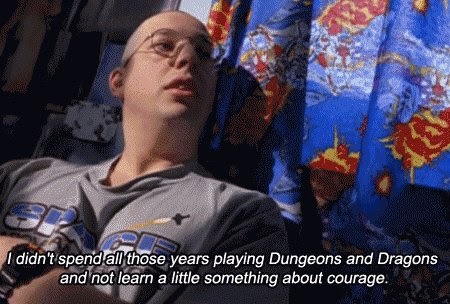
And who knows? After a few years of playing games that have real consequences, even you might just learn a thing or two about courage.