
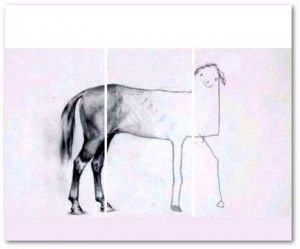
One of the more fascinating developments in mainstream RPG discussion over the past two years has been watching the term “Folk RPG” get coined then attacked then captured, inverted, and redeployed. The people currently using the term use it in a way almost completely opposite from how it was originally conceived. Given the personalities involved, it’s hard to believe this is an accident.
This is not especially unusual in internet culture, but this particular case is particularly revealing because the semantic inversion itself illustrates the exact phenomenon Jeffro was trying to describe.
Which is, admittedly, pretty funny.
Jeffro’s original formulation of the “fake tabletop RPG folk game” was explicitly written as the diagnosis of a terrible disease that had afflicted the hobby for decades. A criticism. A pejorative even.

His argument, stripped to essentials, was that the original Braunstein-derived campaign model possessed a coherent underlying structure:
- persistent worlds,
- 1:1 time,
- referee-managed continuity,
- logistical consequence,
- asymmetrical information,
- and open-table campaign persistence.
Modern RPG culture, meanwhile, inherited the external appearance of roleplaying while gradually losing the structural elements that made the original hobby function. Thus the term, “folk game.” It’s just like this thing, you know, that you can’t really explain or define, you just sort of know it when you see it.
Not “folk” in the warm acoustic-guitar sense. “Folk” in the historical sense:
- fragmented transmission,
- degraded inheritance,
- partial understanding,
- and the survival and importance of ritual after the original operating principles had been forgotten.
This was not a populist slogan. It was an archaeological claim.
Unfortunately, the internet saw the word “folk” and immediately performed internet operations upon it.
Now, to be fair, this confusion did not emerge from nowhere. Prior to Jeffro’s essays, the broader OSR already contained a substantial body of anti-corporate and anti-platform sentiment. Creators like Ben “Yoink!” Milton had discussed, in glowing and appreciative terms, topics such as:
- local table culture,
- house rules,
- DIY publishing,
- and resistance to centralized brand authority.
More recently, as the D&D brand has imploded under the hands of blue-haired fatties and their limp-wristed enablers, he pivoted away from the (™) version of the game and toward the idea that D&D belongs to the players. The hobby is bigger than the corporation, and because the corporation maximizes quantity over quantity, every table was able to develop its own traditions, even while sheltered under the corporate umbrella.
Perfectly reasonable observations, even if his motivations are entirely circumspect.
But his analyses are directed toward the same concepts that Jeffro was talking about.
The OSR conception of decentralized gaming was primarily institutional:
- decentralized publishing (but gimme money),
- decentralized rules ownership (but gimme control),
- decentralized creative authority (but gimme fame).
Jeffro’s critique, meanwhile, was structural.
He did not argue that local variation exists. Of course it exists. It always has, and he encouraged variation at beyond the borders of the agreed-upon ruleset. More to the point, he argued that the hobby lost specific campaign technologies that originally constrained and organized play into coherent forms. Even more specifically, he argued that those technologies were so powerful that they inherently undercut the need for centralized authority – and that they were abandoned for that very reason.
Those are radically different claims.
Unfortunately, once “folk RPG” escaped BROSR containment, the broader hobby culture immediately reinterpreted it to suit its own needs – and what a coinkydink! – in a way that defanged the original meaning’s thrust into the belly of the OSR beast. Which is to say the usual suspects immediately misunderstood the term and promulgated a new version of it, one that emphasized:
- collaborative creativity,
- grassroots ownership,
- table freedom,
- anti-corporate authenticity.
This created the current bizarre situation in which people who fundamentally reject the BrOSR understanding of campaign structure now casually use “Folk RPG” as a synonym for:
- “DIY gaming,”
- “OSR vibes,”
- or “house rules are neat.”
It’s enough to give those of us with a developed sense of pattern recognition the impression that a substantial percentage of online discourse consists of people aggressively agreeing with arguments they have not actually read.
The deeper irony here is that the OSR itself is far from decentralized at the table level. Quite the opposite. “Rulings not rules” does not eliminate authority. It relocates authority.
The corporate publisher loses authority. The referee gains it. And all of them at the expense of players.
This is one of those points that becomes invisible because modern internet culture instinctively interprets all anti-corporate rhetoric as egalitarian rhetoric. But the classic campaign model is not egalitarian in the modern collaborative-storytelling sense. The referee functions as:
- judge,
- world simulator,
- continuity manager,
- information gatekeeper,
- and custodian of objective campaign reality.
This is much closer to a traditional wargame referee or campaign umpire than to a writers’ room.
The BrOSR position is therefore not: “everyone should freely invent whatever they want.”
It is closer to: “the best campaign structures produce objective consequences that constrain play into meaningful forms.”
That is almost the opposite philosophy.
But because modern hobby discourse possesses approximately three conceptual categories total, all anti-corporate positions get flattened into a single aesthetic blob. Thus Jeffro’s critique of degraded campaign inheritance was gradually absorbed into the same semantic bucket as:
- indie DIY culture,
- anti-WOTC sentiment,
- and generalized OSR nostalgia.
The result is a term that now simultaneously means: “healthy decentralized tradition,” AND “degraded inherited misunderstanding.”
Which is confusing, but also strangely appropriate.
After all, if Jeffro is correct, then the reinterpretation of “folk RPG” itself has become a folk process:
- detached from original context,
- transmitted socially,
- partially misunderstood,
- simplified for broader consumption,
- and transformed into something its originator would scarcely recognize.
The term has itself become a folk artifact, as corrupted and degenerated as the D&D brand itself.
You really do have to admire the corrupt efficiency of it.