
Fantasy wargaming has always carried a burden that our modern, jaded, and secularized society shies away from: when you bring dragons and wizards onto a battlefield full of spearmen, you’re no longer just adjudicating combat – you’re adjudicating myth.
Early designers, raised in a culture steeped that lacked our sophisticated refusal to believe in anything but the supreme power of ironic detachment, understood this instinctively. Chainmail, the primordial soup from which all fantasy miniature wargames crawled, didn’t try to flatten everything into one scale of conflict. It recognized that a battlefield contains beings who operate at different narrative magnitudes. Ordinary troops fight in the mud; Heroes stride through the story.
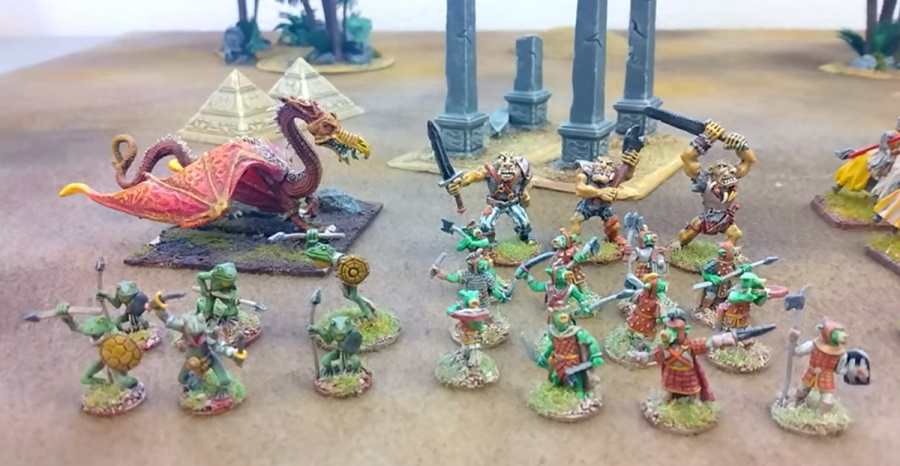
The hierarchy, one of ordinary troops, Heroes, Superheroes, Wizards, and monsters, wasn’t just a rules convenience. It was a worldview. Even if it wasn’t one that Gygax and Perrin consciously understood, it was there. Chainmail assumed that fantasy fiction privileges the individual, and the game built to emulate that fantasy fiction likewise privileges the individual. A Hero in Chainmail is so much more than just a soldier with a +1 sword. He was a different kind of piece on the gameboard.
Warhammer Fantasy Battle 2nd Edition inherits that worldview almost intact, but filters it through the lens of role‑playing culture. A Warhammer character is essentially a Chainmail Hero who wandered into an RPG, picked up a stat block, a backstory, a magic sword, and then marched back onto the battlefield. He’s not just a commander; he’s a guy. He has a full statline, probably a mount with its own stats, a name, and probably a grudge. He can swing a fight, steady a line, or die gloriously. That’s the Chainmail premise expressed through a more theatrical, more personal idiom. And it’s a premise that gamers complained about to the extent that it earned the pejorative sobriquet, HeroHammer.
But HeroHammer preserved the most important part of the experience: the disproportionate impact of the exceptional individual. When you understand that Chainmail owes as much to replicating the experience of Appendix N heroes as it does to providing a historically authentic experience, its odd dual‑system combat makes perfect sense. What most people dismiss as a kludge is really a worldview accurately expressed via rules.
This is what I argued in that earlier post – two systems, one game. Chainmail speaks two dialects because fantasy warfare has two dialects. In Bathton, when the Red Cult tried to abscond with the Sacred Skull of Saint Featherstone, the table wasn’t hosting one battle. It was hosting three. The two levels of narrative focus – the mundane and the mythic – can be combined in three different ways. It’s a narrative rock-paper-scissors and there’s no one right answer, there’s just the tactic that gets you the winning choice of narrative focus.
If you cast off the chains of modern thought and embrace the dual nature of Chainmail, the game flies and it makes perfect sense. My Bathton scenario moved with a pace modern rulesets often lose in their quest for granularity. Even without fatigue, the experience illuminated exactly what Gary was thinking when he built AD&D’s hybrid combat engine. It’s a system meant to handle both the mundane and the mythic without apology.
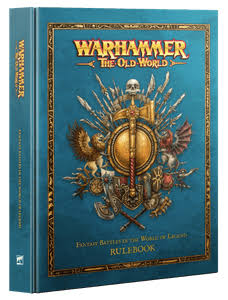
And it’s also why Warhammer 2e feels like Chainmail’s heir. It keeps the dual scales, wraps them in RPG theatrics, and never forgets that fantasy wargaming is ultimately about what happens when myth walks onto the table. As the decades have gone by, the game’s caretakers have sanded off much the magic, and yet it’s hard not to see that The Olde Worlde retains the ghosts of HeroHammer. In our dull and gray world of meaningless secularism, it’s also hard not to see that The Olde World’s embrace of the mythic at the operating level of the rules plays a large role in its continued success.
So if you’ve never tried Chainmail – or if you’ve only read it as a historical curiosity – you owe it to yourself to step onto that mythic battlefield at least once. Cast off the modern instinct to flatten everything into one scale, embrace the dual nature of the rules, and let heroes and monsters distort the fight the way they’re meant to. You’ll find the game moves faster, hits harder, and reveals more about the foundations of fantasy gaming than any amount of commentary ever could. Set a table, gather a handful of figures, and let myth walk onto the field. Then tell me what happened next, because I suspect you’ll see exactly why Chainmail still matters – and why Warhammer’s Olde World can’t escape its past.