

“But wait! My PC would have…”
There’s a theory floating around out there in RPG spaces that shorter game turns come about as a result of a desire to more accurately reflect the realities of action.
The one minute round in AD&D , with it’s profuse hand waving of the details of each cut and thrust gives way to the six second round of post-millennial D&D, which encourages hyper specific paths of travel and demands a description of each feint, parry, and thrust. And then there’s GURPS’ one second round which slices time so thin that you are forced to contend with the tiniest minutiae of your pen-and-paper puppets.
The vast bulk of the theorycrafting that I’ve read about RPG design focus on the issue of simulation. Breaking down the discrete phases of declaration-resolution to the shortest practicable measure, the analysts contend, allows designers and players to incorporate more variables into their decision making process. It allows them to reduce the amount of abstraction going on around here. It’s a dial that allows you to zoom in to the desired level of control.
At least, accuracy is the stated reason.
And yet…
People are never really honest with themselves, are they?
In light of recent experience, I have a counter-theory: shrinking turn rounds are motivated more be a desire to avoid loss, to wrest back control over an inherently uncontrollable situation.
You enter an RPG combat with a desired outcome and state that up front. But the enemy gets a vote. The dice get a vote. And all too often the “impartial” (HA!) referee gets a vote. Things sometimes don’t go your way. So you protest, “We need to look at this a little closer!”
If only your PC could have targeted one specific goblin in the mob. If only you could have been more precise about how your character moved into the fray. If only we could see that your silence spell popped 12 seconds before the enemy’s fireball. If only you could have made a different choice halfway through the process of resolving your previous choices.
You didn’t lose because of bad decisions or because the dice turned against you or because your DM hates you. You lost because the winning choices are only visible at a level below what this game can see.

But the game is what it is, and so you play it for what it is. But the bad taste of losing stays in your mind, and having blamed the game mechanics themselves, you begin to look around for a better game. One designed to let you see the discrete resolution that would have given you a path to success. You grumble in forums and at conventions, and you find that you are not alone. A lot of people share your contention that “if only this game more accurately simulated the process, I would have won.”. Over time this narrative becomes dominant, and some designer somewhere is happy to sell you what you think you want.
So the rounds get shorter, but your win-loss ratio stays the same. Because it doesn’t really matter how short the rounds are, what matters is that the potential for losses remains. And what matters is that your ability to accept your role in those losses remains.
RPGs are, at their core, all the same. If you step back and look at the fundamental processes involved, you can see they are all the same. It’s OODA loops all the way down. You get a description of the situation, you analyze your options, you declare your actions, and then the dice give you a result. A week, a day, a minute, or a second, that OODA loop remains. No matter how thin you slice the clock, that last step remains.
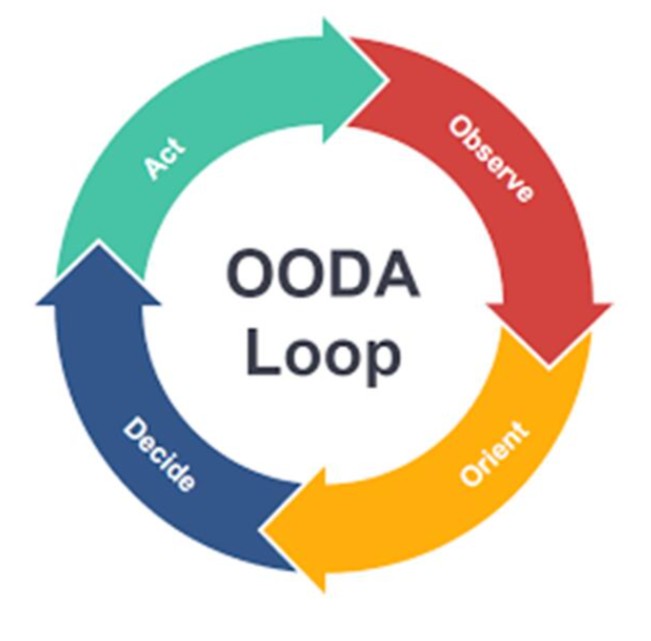
The true aficionado of the RPG experience knows that the last step isn’t the villain. It’s the space where glory is found. The risk of loss allows the hope of success. And the true scholar of the hobby understands that the resolution of the view doesn’t affect his control over the outcome.