
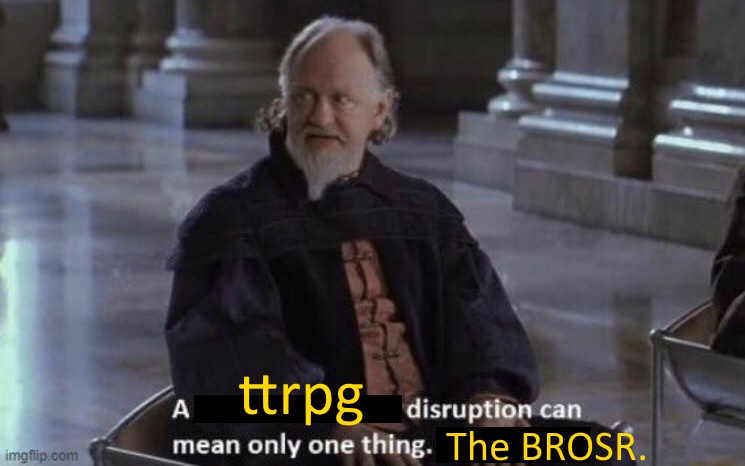
In a previous essay, I argued that the BROSR’s most important evolution has been its shift from polemics to engineering. The movement is no longer trying to convince people to play better; it is building the procedures that make better play possible. They aren’t looking at new siding on an old house, but reinventing the very foundation of campaign infrastructure – they are building a machine that makes a world move and provides unprecedented latitude for players to generate friction, conflict, and content for the campaign. It’s a democratization of the act of creation that you seldom see outside of weird indy experiments like Microscope, and never inteegrated seamlessly with session play and faction play on an ongoing basis.

Inevitably, this leads to sellable content, and sure as God made little green apples where there’s sellable content there are shady publishers looking for new churn and new shortcuts to profit. But what happens to the RPG publishing model when the campaign itself becomes the primary generator of content?
The answer is more provocative than the cautious version suggested earlier. A successful campaign machine doesn’t merely compete with the splatbook treadmill. It makes the treadmill increasingly unnecessary by eliminating the problem the treadmill exists to solve.
The modern RPG publishing model rests on a simple assumption: eventually, the table runs out of material. They use all the monsters in the book, and fiddle with every treasure. They explore all the subsystems or realize that single-resolution systems (like d20) quickly grow stale because once you’ve seen one challenge, you’ve literally seen them all. (Roll higher, bro.) So publishers step in to compensate with new classes, spells, monsters, adventures, settings, and rule expansions. Each new book injects novelty into the game, for a brief time. Structurally, the treadmill is a prosthetic. It supplies what the campaign cannot generate on its own.
A product that manages campaign infrastructure attacks that weakness directly.
When you have a campaign where time actually passes, factions pursue their interests, armies move, alliances form and collapse, rumors spread and information leaks, adventuring parties bust open things best left sealed or recover world-changing powerful artifacts, and all while economic conditions change and nobody knows the full details of any of it…then the consequences of last month’s adventure become the circumstances of this month’s adventure. None of this requires a supplement. It happens because the procedures make it happen.
That is the critical shift. The campaign becomes a content engine. Novelty doesn’t have to arrive from outside the campaign; it emerges from the actions of the people inside it. Once that happens, the economics of the hobby itself begin to change.
The splatbook treadmill works because the publisher is the major source of novelty. But a functioning campaign machine moves the source of novelty from the publisher to the players.
Crucially, the machine doesn’t need to produce finished adventures. It only needs to produce interesting situations. It only needs to produce conflict, stakes, and urgency. The Booker guides the DMs who still exert influence over events at the table – that part doesn’t change. What changes is that a dozen players issue orders that lead to faction conflicts, and a handful of public events that force changes in plans, and now a looming military action become the seeds of adventures.
This is also why campaign infrastructure competes with splatbooks at a deeper level than simply “you don’t need another book.” A splatbook sells disposable toys: subclasses, spells, monsters, magic items, and bolted-on subsystems of rules. Campaign infrastructure manufactures a different kind of toy: threats, opportunities, crises, agendas, factions, domains, political situations, economic problems, and wars. These toys belong to this campaign, and as the ones who generated them the players have a much higher investment in them. They matter because they emerge from decisions already made. They are unpredictable, persistent, and meaningful.
At this point, the economic relationship changes. You don’t buy water when you have a well. You might still buy bottled water because you enjoy it, but you no longer depend on someone else to supply it. In the same way, campaign infrastructure doesn’t make settings, adventures, or splatbooks worthless. But it definitely makes them optional, and optional products are very different from necessary ones.
This shift also undermines a couple of key psychological engine behind the treadmill.
For one, and it is rarely acknowledged, but universally felt, splatbooks come with psychological gravity. They don’t just offer content; they offer constraints. A splatbook tells you what a monster is supposed to be, how a faction is supposed to behave, how a spell is supposed to work, how a setting is supposed to feel. Even when a DM wants to change something, the published version exerts pressure. It whispers: this is the official way. And that whisper shapes the table’s imagination more than most people admit. Ripped from a book, free of the constraints of the designer, it becomes much easier to plug Conan or Elric or Radagast into your campaign. Ripped from a supplement, you shift from player to editor, and you have to be willing to admit that the guy you gave money to for his judgement has worse judgement than the one you exercise for free.
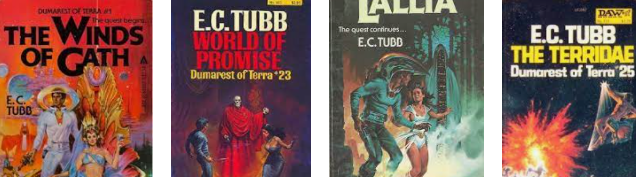
tion, and they will always be a part of the gaming experience. They give the table raw material without telling anyone what the “correct” version is. And in a world where campaign infrastructure is becoming the engine of play, that difference matters more than ever.
This is why literary references are so powerful. They provide content without constraints. They offer inspiration (and a spice of cultural uniformity – “Hey, I remember that movie!”) without prescrip
The other key psychological effect is that a functioning campaign system undermines the splatbook economy’s chief selling point of FOMO – the fear that the next book contains the new options, lore, monsters, or setting everyone else will be using. But once a DM has a functioning system for generating emergent content, the fear of missing out becomes much less powerful. The campaign already contains more potential situations than the table can play through, and if no one else is trying to buy a win by being first to plug the latest high powered supplement into the game then you don’t have to just to keep up. You’ve got everything you need to know right there in the Discord server.
That may be the real disruption. The machine doesn’t beat the splatbook treadmill by producing better splatbooks. It changes the reason the treadmill existed in the first place. And without that reason, a whole lot of publishers don’t have a reason to exist.
No wonder they are so afraid of it.